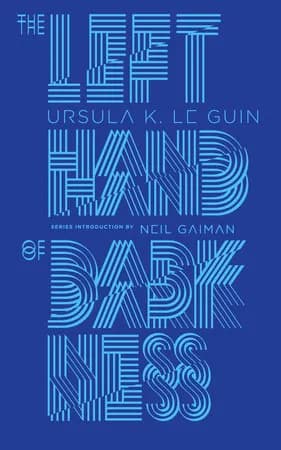
Ursula K. Le Guin
Quotes
Legends of prediction are common throughout the whole Household of Man. Gods speak, spirits speak, computers speak. Oracular ambiguity or statistical probability provides loopholes, and discrepancies are expunged by
How does one hate a country, or love one? [...] I know people, I know towns, farms, hills and rivers and rocks, I know how the sun at sunset in autumn falls on the side of a certain plowland in the hills; but what is the sense of giving a boundary to all that, of giving it a name and ceasing to love where the name ceases to apply? What is love of one's country; is it hate of one's uncountry?
p. 228
The First Envoy to a world always comes alone. One alien is a curiosity, two are an invasion.
p. 209
A man who doesn’t detest a bad government is a fool. And if there were such a thing as a good government on earth, it would be a great joy to serve it.
p. 213
It is not human to be without shame and without desire.
p. 177
It is a terrible thing, this kindness that human beings do not lose. Terrible because when we are finally naked in the dark and cold, it is all
I thought, shivering, that there are things that outweigh comfort, unless one is an old woman or a cat.
p. 51
It is not altogether a bad thing to have criminal ancestors. An arsonist grandfather may bequeath one a nose for smelling smoke.
p. 143
“We in the Handdara don’t want answers. It’s hard to avoid them, but we try to.”
“Faxe, I don’t think I understand.”
“Well, we come here to the Fastnesses mostly to learn what questions not to ask.”
“But you’re the Answerers!”
“You don’t see, Genry, why we perfected and practice Foretelling?”
“No—”
“To exhibit the perfect uselessness of knowing the answer to the wrong question.”
p. 69
The only thing that makes life possible is permanent, intolerable uncertainty: not knowing what comes next.
p. 70
A man can trust his luck, but a society can’t; and cultural change, like random mutation, may make things chancier. So they have gone very slowly. At any one point in their history a hasty observer would say that all technological progress and diffusion had ceased. Yet it never has. Compare the torrent and the glacier. Both get where they are going.
p. 98
I forgot, being too interested myself, that he’s a king, and does not see things rationally, but as a king.
p. 17