Quotes
Proof that one can be both intelligent and accept the intelligence of those who disagree with you? Why, I should think it would undermine the scholarly world in its entirety.
p. 460
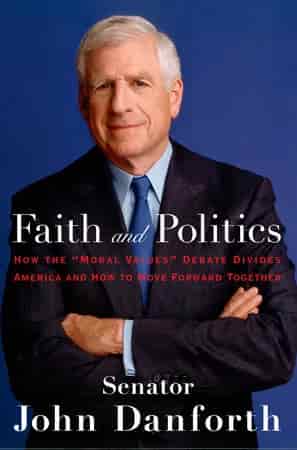
The problem is not that Christians are conservative or liberal, but that some are so confident that their position is God's position that they become dismissive and intolerant toward others and divisive forces in our national life.
p. 10
[W]hatever you are is never enough; you must find a way to accept something, however small, from the other to make you whole and to save you from the mortal sin of righteousness and extremism. (p. 154)
We shall all live. We pray for life, children, a good harvest and happiness. You will have what is good for you and I will have what is good for me. Let the kite perch and let the egret perch too. If one says no to the other, let his wing break.
p. 22
Difference of opinion is advantageous in religion. The several sects perforin the office of a censor morum over each other. Is uniformity attainable? Millions of innocent men, women and children, since the introduction of Christianity, have been burnt, tortured, fined, imprisoned; yet we have not advanced one inch towards uniformity. What has been the effect of coercion? To make one-half the world fools, and the other half hypocrites. To support roguery and error all over the earth. Let us reflect that it is inhabited by a thousand millions of people. That these profess probably a thousand different systems of religion. That ours is but one of that thousand. That if there be but one right, and ours that one, we should wish to see the 999 wandering sects gathered into the fold of truth. But against such a majority we cannot effect this by force. Reason and persuasion are the only practicable instruments. To make way for these, free enquiry must be indulged; and how can we wish others to indulge it while we refuse it ourselves. But every state, says an inquisitor, has established some religion. No two, say I, have established the same. Is this a proof of the infallibility of establishments? Our sister states of Pennsylvania and New York, however, have long subsisted without any establishment at all.
p. 172
Subject opinion to coercion: whom will you make your inquisitors? Fallible men; men governed by bad passions, by private as well as public reasons.
p. 171
The error seems not sufficiently eradicated, that the operations of the mind, as well as the acts of the body, are subject to the coercion of the laws. But our rulers can have authority over such natural rights only as we have submitted to them. The rights of conscience we never submitted, we could not submit. We are answerable for them to our God. The legitimate powers of government extend to such acts only as are injurious to others. But it does me no injury for my neighbour to say there are twenty gods, or no god. It neither picks my pocket nor breaks my leg. If it be said, his testimony in a court of justice cannot be relied on, reject it then, and be the stigma on him. Constraint may make him worse by making him a hypocrite, but it will never make him a truer man. It may fix him obstinately in his errors, but will not cure them. Reason and free enquiry are the only effectual agents against error. Give a loose to them, they will support the true religion, by bringing every false one to their tribunal, to the test of their investigation. They are the natural enemies of error, and of error only. Had not the Roman government permitted free enquiry, Christianity could never have been introduced. Had not free enquiry been indulged, at the aera of the reformation, the corruptions of Christianity could not have been purged away. If it be restrained now, the present corruptions will be protected, and new ones encouraged. Was the government to prescribe to us our medicine and diet, our bodies would be in such keeping as our souls are now. Thus in France the emetic was once forbidden as a medicine, and the potatoe as an article of food.
p. 170
Does the vacuousness of Western universalism and the reality of global cultural diversity lead inevitably and irrevocably to moral and cultural relativism? If universalism legitimates imperialism, does relativism legitimate repression? Once again, the answer to these questions is yes and no. Cultures are relative; morality is absolute. Cultures, as Michael Walzer has argued, are “thick”; they prescribe institutions and behavior patterns to guide humans in the paths which are right in a particular society. Above, beyond, and growing out of this maximalist morality, however, is a “thin” minimalist morality that embodies “reiterated features of particular thick or maximal moralities.” Minimal moral concepts of truth and justice are found in all thick moralities and cannot be divorced from them. There are also minimal moral “negative injunctions, most likely, rules against murder, deceit, torture, oppression, and tyranny.” What people have in common is “more the sense of a common enemy [or evil] than the commitment to a common culture.” Human society is “universal because it is human, particular because it is a society.” At times we march with others; mostly we march alone. Yet a “thin” minimal morality does derive from the common human condition, and “universal dispositions” are found in all cultures. Instead of promoting the supposedly universal features of one civilization, the requisites for cultural coexistence demand a search for what is common to most civilizations. In a multicivilizational world, the constructive course is to renounce universalism, accept diversity, and seek commonalities.
p. 319
An ecosystem is more like a conference than a community -- indefinite, pluralistic, tolerant, and in constant flux.
“They were always telling me their way is the only way to go!”
“Oh, no, my dear. No, not at all. So long as it harms no one else, one’s own way is always preferable.”
p. 59
I’ve met the prophet Awateh, and he’s very religious, but he’s also completely off his head. It seems to me religious toleration stops when they intend to kill you or hurt you with it. Africa, that’s my aunt, she always said noninterference was a two-way street.
p. 397
Humans were genetically inclined to be intolerant of difference. They could overcome the inclination, but it was a reality of the Human conflict that they often did not.
p. 710