Quotes
Planets were very large places, on any scale but that of the spaces in between them.
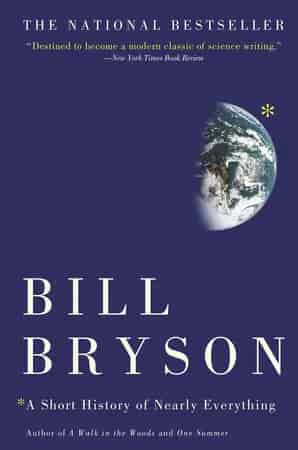
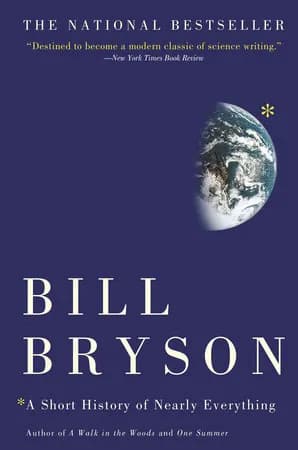
As Edward P. Tryon of Columbia University once put it: "In answer to the question of why it happened, I offer the modest proposal that our universe is simply one of those things that happen from time to time." To which adds Guth: "Although the creation of a universe might be very unlikely, Tryon emphasized that no one had counted the failed attempts."
All that can really be said is that at some indeterminate point in the very distant past, for reasons unknown, there came the moment known to science as t = 0. We were on our way.
p. 10
It is as inescapable as the laws of physics that humanity will one day confront some type of extinction-level event. But will we, like our ancestors, have the drive and determination to survive and even flourish? . . . On a scale of decades, we face threats that are not natural but are largely self-inflicted [including] global warming . . . modern warfare as nuclear weapons proliferate in some of the most unstable regions of the globe, [or] weaponized microbes [that could conceivably] wipe out 98 percent of the human race. . . . On a scale of thousands of years, we face the onset of another ice age [or] the possibility that the supervolcano under Yellowstone National Park may awaken from its long slumber . . . . On a scale of millions of years, we face the threat of another meteor or cometary impact . . . . We now know that there are several thousand NEOs (near-Earth objects) that cross the orbit of the Earth and pose a danger to life on our planet. . . . If there is one lesson we can learn from our history, it is that humanity, when faced with life-threatening crises, has risen to the challenge and reached for even higher goals. In some sense, the spirit of exploration is in our genes and hardwired into our soul. [So] now we face perhaps the greatest challenge of all: to leave the confines of Earth and soar into outer space. . . . Perhaps our fate is to become a multiplanet species that lives among the stars.
"Killer asteroids are nature's way of asking, 'How's that space program coming along?'" - Anonymous
p. 54
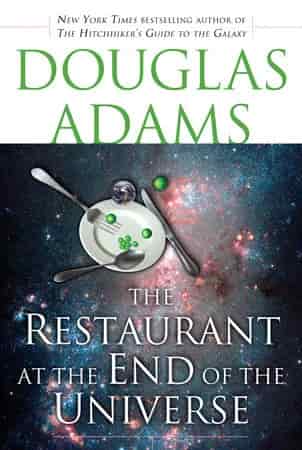
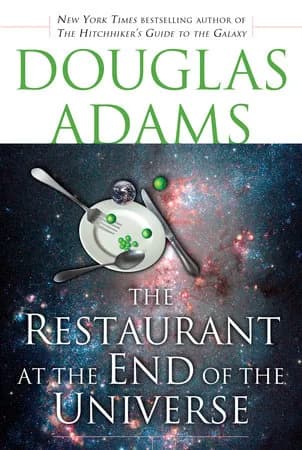
If you'd like to know, I can tell you that in your universe you move freely in three dimensions that you call space. You move in a straight line in a fourth, which you call time, and stay rooted to one place in a fifth, which is the first fundamental of probability. After that it gets a bit complicated, and there's all sort of stuff going on in dimensions thirteen to twenty-two that you really wouldn't want to know about. All you really need to know for the moment is that the universe is a lot more complicated than you might think, even if you start from a position of thinking it's pretty damn complicated in the first place. I can easily not say words like "damn" if it offends you.
He was wrong to think he could now forget that the big, hard, oily, dirty, rainbow-hung Earth on which he lived was a microscopic dot on a microscopic dot lost in the unimaginable infinity of the Universe.
The Total Perspective Vortex derives its picture of the whole Universe on the principle of extrapolated matter analyses.
To explain—since every piece of matter in the Universe is in some way affected by every other piece of matter in the Universe, it is in theory possible to extrapolate the whole of creation—every sun, every planet, their orbits, their composition and their economic and social history from, say, one small piece of fairy cake.
The man who invented the Total Perspective Vortex did so basically in order to annoy his wife.
Trin Tragula—for that was his name—was a dreamer, a thinker, a speculative philosopher or, as his wife would have it, an idiot.
And she would nag him incessantly about the utterly inordinate amount of time he spent staring out into space, or mulling over the mechanics of safety pins, or doing spectrographic analyses of pieces of fairy cake.
"Have some sense of proportion!" she would say, sometimes as often as thirty-eight times in a single day.
And so he built the Total Perspective Vortex—just to show her.
And into one end he plugged the whole of reality as extrapolated from a piece of fairy cake, and into the other end he plugged his wife: so that when he turned it on she saw in one instant the whole infinity of creation and herself in relation to it.
To Trin Tragula's horror, the shock completely annihilated her brain; but to his satisfaction he realized that he had proved conclusively that if life is going to exist in a Universe of this size, then the one thing it cannot afford to have is a sense of proportion.
The story so far:
In the beginning the Universe was created.
This has made a lot of people very angry and been widely regarded as a bad move.
There is a theory which states that if ever anyone discovers exactly what the Universe is for and why it is here, it will instantly disappear and be replaced by something even more bizarre and inexplicable.
There is another theory which states that this has already happened.
It is known that there are an infinite number of worlds, simply because there is an infinite amount of space for them to be in. However, not every one of them is inhabited. Therefore, there must be a finite number of inhabited worlds. Any finite number divided by infinity is as near to nothing as makes no odds, so the average population of all the planets in the Universe can be said to be zero. From this it follows that the population of the whole Universe is also zero, and that any people you may meet from time to time are merely the products of a deranged imagination.
Looking up into the night sky is looking into infinity—distance is incomprehensible and therefore meaningless.