Quotes
We go to Nature for comfort in trouble, and sympathy in joy, only in books. Admiration of those beauties of the inanimate world, which modern poetry so largely and so eloquently describes, is not, even in the best of us, one of the original instincts of our nature. As children, we none of us possess it. No uninstructed man or woman possesses it. Those whose lives are most exclusively passed amid the ever-changing wonders of sea and land are also those who are most universally insensible to every aspect of Nature not directly associated with the human interest of their calling. Our capacity of appreciating the beauties of the earth we live on is, in truth, one of the civilised accomplishments which we all learn as an Art; and, more, that very capacity is rarely practised by any of us except when our minds are most indolent and most unoccupied. How much share have the attractions of Nature ever had in the pleasurable or painful interests and emotions of ourselves or our friends? What space do they ever occupy in the thousand little narratives of personal experience which pass every day by word of mouth from one of us to the other? All that our minds can compass, all that our hearts can learn, can be accomplished with equal certainty, equal profit, and equal satisfaction to ourselves, in the poorest as in the richest prospect that the face of the earth can show. There is surely a reason for this want of inborn sympathy between the creature and the creation around it, a reason which may perhaps be found in the widely-differing destinies of man and his earthly sphere. The grandest mountain prospect that the eye can range over is appointed to annihilation. The smallest human interest that the pure heart can feel is appointed to immortality.
The world has created no living thing that it does not intend to destroy.
The world has no name, he said. The names of the cerros and the sierras and the deserts exist only on maps. We name them so that we do not lose our way. Yet it was because the way was lost to us already that we have made those names. The world cannot be lost. We are the ones. And it is because these names and these coordinates are our own naming that they cannot save us. That they cannot find for us the way again.
It was a beautiful afternoon; one to make you realise that God really can be very good sometimes with weather and scenery.
We should bow deeply before the orchid and the snail and join our palms reverently before the monarch butterfly and the magnolia tree. The feeling of respect for all species will help us recognize the noblest nature in ourselves.
Birds' songs express joy, beauty, and purity, and evoke in us vitality and love. So many beings in the universe love us unconditionally. The trees, the water, and the air don't ask anything of us; they just love us. Even though we need this kind of love, we continue to destroy them. By destroying the animals, the air, and the trees, we are destroying ourselves. We must learn to practice unconditional love for all beings so that the animals, the air, the trees, and the minerals can continue to be themselves.
Our ecology should be a deep ecology—not only deep, but universal. There is pollution in our consciousness. Television, films, and newspapers are forms of pollution for us and our children. They sow seeds of violence and anxiety in us and pollute our consciousness, just as we destroy our environment by farming with chemicals, clear-cutting the trees, and polluting the water. We need to protect the ecology of the Earth and the ecology of the mind, or this kind of violence and recklessness will spill over into even more areas of life.
All life is impermanent. We are all children of the Earth, and, at some time, she will take us back to herself again. We are continually arising from Mother Earth, being nurtured by her, and then returning to her. Like us, plants are born, live for a period of time, and then return to the Earth. When they decompose, they fertilize our gardens. Living vegetables and decomposing vegetables are part of the same reality. Without one, the other cannot be. After six months, compost becomes fresh vegetables again. Plants and the Earth rely on each other. Whether the Earth is fresh, beautiful, and green, or arid and parched depends on the plants.
It also depends on us. Our way of walking on the Earth has a great influence on animals and plants. We have killed so many animals and plants and destroyed their environments. Many are now extinct. In turn, our environment is now harming us. We are like sleepwalkers, not knowing what we are doing or where we are heading. Whether we can wake up or not depends on whether we can walk mindfully on our Mother Earth. The future of all life, including our own, depends on our mindful steps.
p. 3
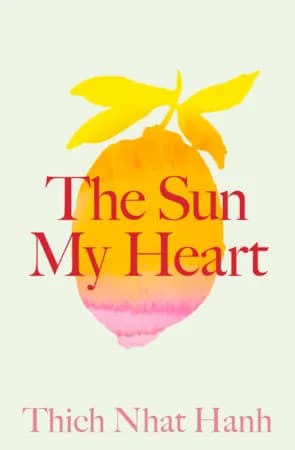
One day I suddenly saw that the sun is my heart, my heart outside of this body. If my body's heart ceases to function I cannot survive; but if the sun, my other heart, ceases to function, I will also die immediately. We should be able to be our true self. That means we should be able to be the river, we should be able to be the forest, we should be able to be a citizen of any country in the world. We must do this to understand, and to have hope for the future. That is the nondualistic way of seeing.
Life is in the business of making its environment agreeable for life.
The world of our own making has become so complicated that we must turn to the world of the born to understand how to manage it.
Animals in the wild lead lives of compulsion and necessity within an unforgiving social hierarchy in an environment where the supply of fear is high and the supply of food is low and where territory must constantly be defended and parasites forever endured.
p. 17
Ah, Moon of my Delight who know'st no wane,
The Moon of Heav'n is rising once again:
How oft hereafter rising shall she look
Through this same Garden after me — in vain!