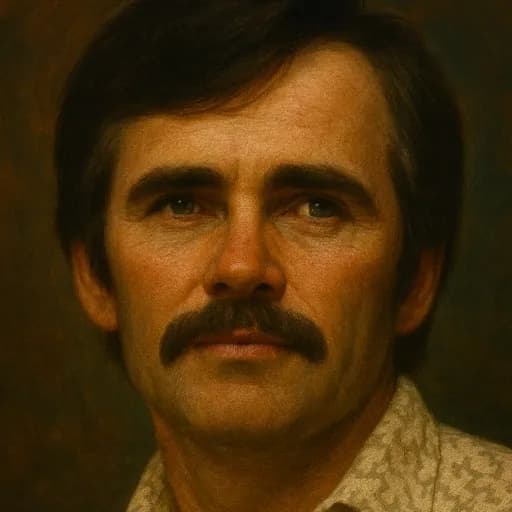
Cormac McCarthy
Quotes
[Which is worse: to be poor or to be an American?]
Spanish: "People say the coyote is a witch. Most of the time, the witch is a coyote."
p. 75
Where is your country? he said.
I don't know, said John Grady. I don't know where it is. I don't know what happens to country.
He thought he'd be an object of some curiosity but the people he saw only nodded gravely to him and passed on. He carried the bucket back into the store and went down the street to where there was a small cafe and he entered and sat at one of the three small wooden tables. The floor of the cafe was packed mud newly swept and he was the only customer. He stood the rifle against the wall and ordered huevos revueltos and a cup of chocolate and he sat and waited for it to come and then he ate very slowly. The food was rich to his taste and the chocolate was made with canela and he drank it and ordered another and folded a tortilla and ate and watched the horses standing in the square across the street and watched the girls. They'd hung the gazebo with crepe and it looked like a festooned brush-pile. The proprietor showed him great courtesy and brought him fresh tortillas hot from the comal and told him that there was to be a wedding and that it would be a pity if it rained. He inquired where he might be from and showed surprise he'd come so far. He stood at the window of the empty cafe and watched the activities in the square and he said that it was good that God kept the truths of life from the young as they were starting out or else they'd have no heart to start at all.
It is supposed to be true that those who do not know history are doomed to repeat it. I don’t believe knowing can save us. What is constant in history is greed and foolishness and a love of blood, and this is a thing that even God—who knows all that can be known—seems powerless to change.
I cant back up and start over. But I dont see the point in slobberin over it. And I cant see where it would make me feel better to be able to point a finger at somebody else.
He lay listening to the horse crop the grass at his stakerope and he listened to the wind in the emptiness and watched stars trace the arc of the hemisphere and die in the darkness at the edge of the world and as he lay there the agony in his heart was like a stake. He imagined the pain of the world to be like some formless parasitic being seeking out the warmth of human souls wherein to incubate and he thought he knew what made one liable to its visitations. What he had not known was that it was mindless and so had no way to know the limits of those souls and what he feared was that there might be no limits.
He remembered Alejandra and the sadness he'd first seen in the slope of her shoulders which he'd presumed to understand and of which he knew nothing and he felt a loneliness he'd not known since he was a child and he felt wholly alien to the world although he loved it still. He thought that in the beauty of the world were hid a secret. He thought the world's heart beat at some terrible cost and that the world's pain and its beauty moved in a relationship of diverging equity and that in this headlong deficit the blood of multitudes might ultimately be exacted for the vision of a single flower.
She came from the shower wrapped in a towel and she sat on the bed and took his hand and looked down at him. I cannot do what you ask, she said. I love you. But I cannot. He saw very clearly how all his life led only to this moment and all after led nowhere at all. He felt something cold and soulless enter him like another being and he imagined that it smiled malignly and he had no reason to believe that it would ever leave.
There aint but one truth, said John Grady. The truth is what happened. It aint what come out of somebody's mouth.
Beware gentle knight. There is no greater monster than reason.
It is not my experience that life’s difficulties make people more charitable.