Quotes
“Knowledge is power.” This is the sentence that dug the grave of philosophy in the nineteenth century. … This sentence brings to an end the tradition of a knowledge that, as its name indicates, was an erotic theory—the love of truth and the truth through love (Liebeswahrheit). … Those who utter the sentence reveal the truth. However, with the utterance they want to achieve more than truth: They want to intervene in the game of power.
In our thinking there is no longer any spark of the uplifting flight of concepts or of the ecstasies of understanding. We are enlightened, we are apathetic. No one talks anymore of a love of wisdom. There is no longer any knowledge whose friend (philos) one could be. It does not occur to us to love the kind of knowledge we have; rather we ask ourselves how we might contrive to live with it without becoming ossified.
Theoretical knowledge is only a small and by no means the most important part of what passed for knowledge in a society… the primary knowledge about the institutional order is knowledge... is the sum total of ‘what everybody knows’ about a social world, an assemblage of maxims, morals, proverbial nuggets of wisdom, values and beliefs, myths, and so forth.
p. 65
It will be enough, for our purposes, to define 'reality' as a quality appertaining to phenomena that we recognize as having a being independent of our own volition (we cannot 'wish them away'), and to define 'knowledge' as the certainty that phenomena are real and that they possess specific characteristics.
p. 1
Socrates affirmed that only that which the reader already knows can be sparked by a reading, and that the knowledge cannot be acquired through dead letters.
We are at an extraordinary moment in human history: never before has the possibility of true democracy been so close to realisation. At the cost of publishing and duplication has dropped to near zero, a truly free press, and a truly informed public, becomes a reality. A new Information Enlightment is dawning where knowledge flows freely, beyond national boundaries. Technology is breaking down traditional social barriers of status, class, power, wealth and geography, replacing them with an ethos of collaboration and transparency. In this new Enlightenment it isn't just scientific truths that are the goal, but discovering truths about the way we live, about politics and power.
The educated don't get that way by memorizing facts; they get that way by respecting them.
As water flows from high to low, knowledge has always flowed from where there is more to where there is less. Those countries that are better at absorbing the knowledge inflow have been more successful in catching up with the more economically advanced nations. On the other side of the fence, those advanced nations that are good at controlling the outflow of core technologies have retained their technological leadership for longer. The technological '', between backward countries trying to acquire advanced foreign knowledge and the advanced countries trying to prevent its outflow has always been at the heart of the game of .
p. 127
The foundation of economic development is the acquisition of more productive knowledge.
p. 142
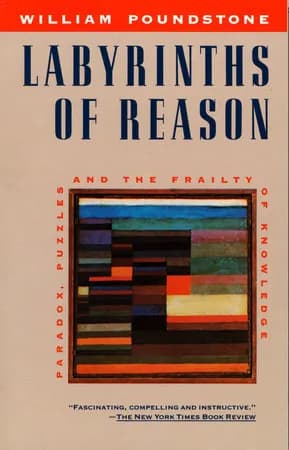
The assumption that anything true is knowable is the grandfather of paradoxes.
p. 260
If your ambition is to maximize short-term gain without regard to the long-term cost, you are better off not knowing the cost. If you want to preserve your personal immunity to the hard problems, it's better never to really understand those problems. There is an upside to ignorance, and a downside to knowledge. Knowledge makes life messier. It makes it a bit more difficult for a person who wishes to shrink the world to a worldview.
p. 77
Never assume that any fact is useless until it is so proven.
p. 62