Quotes about god
539 quotes · 191 authors
Quotes
In us there is the Light of Nature, and that Light is God.
Is it the gods who set this fire in our hearts, or do we each make our fierce desire into a god?
p. 66
He always asked, why thus? why this way, not another way? I answered: Because in what we do daily and in the way we do it, we enact the gods. He said: Then the gods are only what we do. I said: In what we do rightly, the gods are.
p. 106
A person who believes, as she did, that things fit: that there is a whole of which one is a part, and that in being a part one is whole: such a person has no desire whatever, at any time, to play God. Only those who have denied their being yearn to play at it.
On Aka, god is a word without referent. No capital letters. No creator, only creation. No eternal father to reward and punish, justify injustice, ordain cruelty, offer salvation. Eternity not an endpoint but a continuity. Primal division of being into material and spiritual only as two-as-one, or one in two aspects. [...] The Akan system is a spiritual discipline with spiritual goals, but they're exactly the same goals it seeks for bodily and ethical well-being. Right action is its own reward. Dharma without karma.
p. 94
To be an atheist is to maintain God. His existence or his nonexistence, it amounts to much the same, on the plane of proof. Thus proof is a word not often used among the Handdarata, who have chosen not to treat God as a fact, subject either to proof or to belief: and they have broken the circle, and go free.
To learn which questions are unanswerable, and not to answer them: this skill is most needful in times of stress and darkness.
p. 151
We of Es Toch tell a little myth, which says that in the beginning the Creator told a great lie. For there was nothing at all, but the Creator spoke, saying, It exists. And behold, in order that the lie of God might be God’s truth, the universe at once began to exist.
It is sometimes helpful to differentiate between the God of Miracles and the God of Order. When scientists use the word God, they usually mean the God of Order. ...The God of Miracles intervenes in our affairs, performs miracles, destroys wicked cities, smites enemy armies, drowns the Pharaoh's troops, and avenges the pure and noble. ...This is not to say that miracles cannot happen, only that they are outside what is commonly called science.
p. 330
In the Bible, God instructs Moses to burn incense sweet and to His liking. Does God have nostrils? How can a god prefer one smell of this earth to another? The rudiments of decay complete a cycle necessary for growth and deliverance. Carrion smells offensive to us, but delicious to those animals who rely on it for food. What they excrete will make the soil rich and the crops abundant. There is no need for divine election. Perception is itself a form of grace.
p. 301
As with most unwitting servants of the gods, once the game was done so was the servant’s life.
p. 563
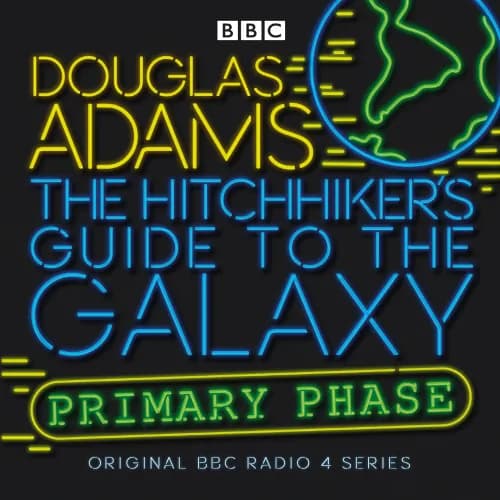
"The Babel fish," said The Hitchhiker's Guide to the Galaxy quietly, "is small, yellow and leech-like, and probably the oddest thing in the Universe. It feeds on brainwave energy received not from its own carrier but from those around it. It absorbs all unconscious mental frequencies from this brainwave energy to nourish itself with. It then excretes into the mind of its carrier a telepathic matrix formed by combining the conscious thought frequencies with nerve signals picked up from the speech centres of the brain which has supplied them. The practical upshot of all this is that if you stick a Babel fish in your ear you can instantly understand anything in any form of language. The speech patterns you actually hear decode the brainwave matrix which has been fed into your mind by your Babel fish.
"Now it is such a bizarrely improbable coincidence that anything so mindbogglingly useful could have evolved purely by chance that some thinkers have chosen to see it as the final and clinching proof of the non-existence of God.
"The argument goes something like this: 'I refuse to prove that I exist,' says God, 'for proof denies faith, and without faith I am nothing.'
"'But,' says Man, 'the Babel fish is a dead giveaway, isn't it? It could not have evolved by chance. It proves you exist, and so therefore, by your own arguments, you don't. QED.'
"'Oh dear,' says God, 'I hadn't thought of that,' and promptly vanishes in a puff of logic.
"'Oh, that was easy,' says Man, and for an encore goes on to prove that black is white and gets himself killed on the next zebra crossing.
"Most leading theologians claim that this argument is a load of dingo's kidneys, but that didn't stop Oolon Colluphid making a small fortune when he used it as the central theme of his bestselling book, Well That about Wraps It Up for God.
"Meanwhile, the poor Babel fish, by effectively removing all barriers to communication between different races and cultures, has caused more and bloodier wars than anything else in the history of creation."
The ecological teaching of the Bible is simply inescapable: God made the world because He wanted it made. He thinks the world is good, and He loves it. It is His world; He has never relinquished title to it. And He has never revoked the conditions, bearing on His gift to us of the use of it, that oblige us to take excellent care of it.