Quotes about evolution
146 quotes · 63 authors
Quotes
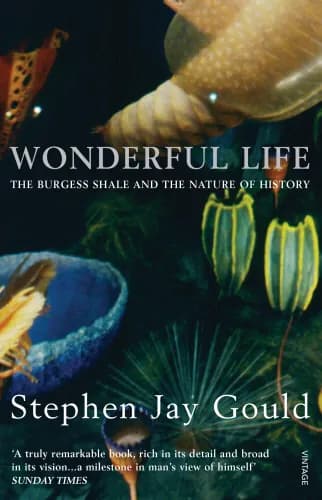
The vigorous branching of life's tree, and not the accumulating valor of mythical marches to progress, lies behind the persistence and expansion of organic diversity in our tough and constantly stressful world. And if we do not grasp the fundamental nature of branching as the key to life's passage across the geological stage, we will never understand evolution aright.
p. 331
Evolution is an obstacle course not a freeway; the correct analogue for long-term success is a distant punt receiver evading legions of would-be tacklers in an oddly zigzagged path toward a goal, not a horse thundering down the flat.
p. 318
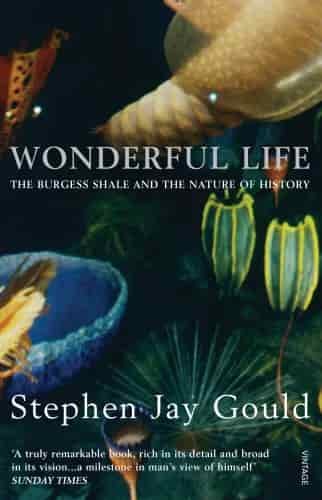
The animals of the Burgess Shale are holy objects—in the unconventional sense that this word conveys in some cultures. We do not place them on pedestals and worship from afar. We climb mountains and dynamite hillsides to find them. We quarry them, split them, carve them, draw them, and dissect them, struggling to wrest their secrets. We vilify and curse them for their damnable intransigence. They are grubby little creatures of a sea floor 530 million years old, but we greet them with awe because they are the Old Ones, and they are trying to tell us something.
p. 52
Each worldview was a cultural product, but evolution is true and separate creation is not. […] Worldviews are social constructions, and they channel the search for facts. But facts are found and knowledge progresses, however fitfully. Fact and theory are intertwined, and all great scientists understand the interaction.
p. 425
Bacteria represent the world's greatest success story. They are today and have always been the modal organisms on earth; they cannot be nuked to oblivion and will outlive us all. This time is their time, not the “age of mammals” as our textbooks chauvinistically proclaim. But their price for such success is permanent relegation to a microworld, and they cannot know the joy and pain of consciousness. We live in a universe of trade-offs; complexity and persistence do not work well as partners.
p. 98
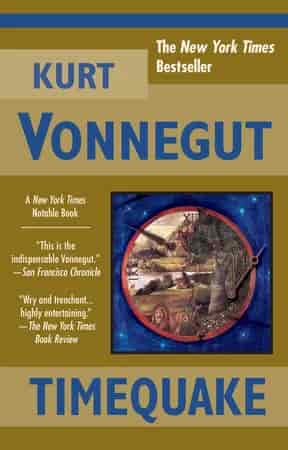
Evolution is so creative. That's how we got giraffes.
The British astronomer Fred Hoyle said something to this effect: The believing in Darwin’s theoretical mechanisms of evolution was like believing that a hurricane could blow through a junkyard and build a Boeing 747. No matter what is doing the creating. I have to say that the giraffe and the rhinoceros are ridiculous. And so is the human brain, capable, in cahoots with the more sensitive parts of the body, such as the ding-dong, of hating life while pretending to love it, and behaving accordingly: "Somebody shoot me while I’m happy!"
p. 188
Evolution is all about processes that almost never happen. Every birth in every lineage is a potential speciation event, but speciation almost never happens, not once in a million births. Mutation in DNA almost never happens — not once in a trillion copings — but evolution depends on it. Take the set of infrequent accidents — things that almost never happen — and sort them into the happy accidents, the neutral accidents, and the fatal accidents; amplify the effects of the happy accidents — which happens automatically when you have replication and competition — and you get evolution.
The evidence of evolution pours in, not only from geology, paleontology, biogeography, and anatomy (Darwin's chief sources), but from molecular biology and every other branch of the life sciences. To put it bluntly but fairly, anyone today who doubts that the variety of life on this planet was produced by a process of evolution is simply ignorant — inexcusably ignorant, in a world where three out of four people have learned to read and write. Doubts about the power of Darwin's idea of natural selection to explain this evolutionary process are still intellectually respectable, however, although the burden of proof for such skepticism has become immense...
The fundamental core of contemporary Darwinism, the theory of DNA-based reproduction and evolution, is now beyond dispute among scientists. It demonstrates its power every day, contributing crucially to the explanation of planet-sized facts of geology and meteorology, through middle-sized facts of ecology and agronomy, down to the latest microscopic facts of genetic engineering. It unifies all of biology and the history of our planet into a single grand story. Like Gulliver tied down in Lilliput, it is unbudgable, not because of some one or two huge chains of argument that might — hope against hope — have weak links in them, but because it is securely tied by thousands of threads of evidence anchoring it to virtually every other area of human knowledge. New discoveries may conceivably lead to dramatic, even "revolutionary" shifts in the Darwinian theory, but the hope that it will be "refuted" by some shattering breakthrough is about as reasonable as the hope that we will return to a geocentric vision and discard Copernicus.
To produce the genetic alteration of an organism, place it in an environment which is dangerous but not lethal.
Let's say there's a molecule that produces a religious experience... a natural molecule that the body produces whose function it is to produce religious experiences, at least on occasion? ...So let's call it "theophorin"...What could the selective advantage of theophorin be? ...to suit us for the quest that was, according to Dostoyevsky, to strive for nothing so incessantly and so painfully as to find someone to worship and obey.