Quotes about evolution
146 quotes · 63 authors
Quotes
The origin of life happened in significantly less than 500 million years. ...Six days was once a popular hypothesis. ...A process that happens quickly is a process that is in some sense likely... this evidence suggests that the origin of life was in some sense easy, in some sense sitting in the laws of physics and chemistry.
Because it is clear from the fossil record that almost every species that has ever existed is extinct; extinction is the rule, survival is the exception.
Suppose your father... walked into this room at the ordinary human pace of walking. And suppose just behind him was his father. How long would we have to wait before the ancestor who enters the now-open door is a creature who normally walked on all fours? The answer is a week.
When you look more generally at life on Earth, you find that it is all the same kind of life. ...It uses about fifty fundamental biological building blocks, organic molecules. ...with trivial exceptions, all organisms on Earth use... an enzyme, to control the rate and direction of the chemistry of life. ...a nucleic acid to encode the hereditary information ...the identical code book for translating nucleic acid language into protein language. ...At the molecular level, we are all virtually identical.
The fossil record implies trial and error, an inability to anticipate the future, features inconsistent with an efficient Great Designer.
p. 29
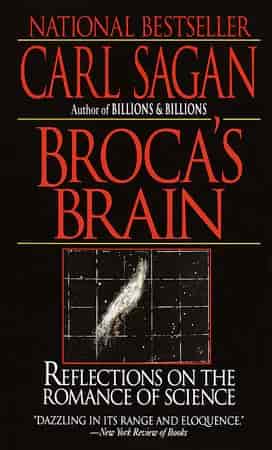
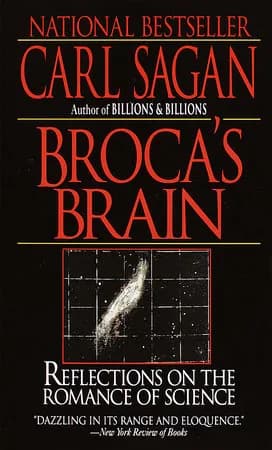
Broca was quoted as saying, “I would rather be a transformed ape than a degenerate son of Adam.”
p. 7
There is a popular contention that half or more of the brain is unused. From an evolutionary point of view this would be quite extraordinary: why should it have evolved if it had no function? But actually the statement is made on very little evidence.
p. 31
Note that in all this interaction between mutation and natural selection, no moth is making a conscious effort to adapt to a changed environment. The process is random and statistical.
p. 28
Natural selection has served as a kind of intellectual sieve, producing brains and intelligences increasingly competent to deal with the laws of nature. This resonance, extracted by natural selection, between our brains and the universe may help explain a quandary set by Einstein: The most incomprehensible property of the universe, he said, is that it is so comprehensible.
p. 242
That in nonarithmetic operations the small and slow human brain can still do so much better than the large and fast electronic computer is an impressive tribute to how cleverly the brain is packaged and programmed—features brought about, of course, by natural selection. Those who possessed poorly programmed brains eventually did not live long enough to reproduce.
p. 224
The entire evolutionary record on our planet, particularly the record contained in fossil endocasts, illustrates a progressive tendency toward intelligence. There is nothing mysterious about this: smart organisms by and large survive better and leave more offspring than stupid ones.
p. 240
In fact, for a voluntarist like Schopenhauer, a theory so sanely and cautiously empirical and rational as that of Darwin, left out of account the inward force, the essential motive, of evolution. For what is, in effect, the hidden force, the ultimate agent, which impels organisms to perpetuate themselves and to fight for their persistence and propagation? Selection, adaptation, heredity, these are only external conditions. This inner, essential force has been called will on the supposition that there exists also in other beings that which we feel in ourselves as a feeling of will, the impulse to be everything, to be others as well as ourselves yet without ceasing to be what we are.