Quotes
The law should regulate in certain areas of culture — but it should regulate culture only where that regulation does good. Yet lawyers rarely test their power, or the power they promote, against this simple pragmatic question: "Will it do good?" When challenged about the expanding reach of the law, the lawyer answers, "Why not?"
We should ask, "Why?" Show me why your regulation of culture is needed. Show me how it does good. And until you can show me both, keep your lawyers away.
A simple idea blinds us, and under the cover of darkness, much happens that most of us would reject if any of us looked. So uncritically do we accept the idea of property in ideas that we don't even notice how monstrous it is to deny ideas to a people who are dying without them. So uncritically do we accept the idea of property in culture that we don't even question when the control of that property removes our ability, as a people, to develop our culture democratically. Blindness becomes our common sense. And the challenge for anyone who would reclaim the right to cultivate our culture is to find a way to make this common sense open its eyes.
So far, common sense sleeps. There is no revolt. Common sense does not yet see what there could be to revolt about.
There has never been a time in history when more of our "culture" was as "owned" as it is now. And yet there has never been a time when the concentration of power to control the uses of culture has been as unquestioningly accepted as it is now.
We will not reclaim a free culture by individual action alone. It will also take important reforms of laws. We have a long way to go before the politicians will listen to these ideas and implement these reforms. But that also means that we have time to build awareness around the changes that we need.
Of all the creative work produced by humans anywhere, a tiny fraction has continuing commercial value. For that tiny fraction, the copyright is a crucially important legal device. For that tiny fraction, the copyright creates incentives to produce and distribute the creative work. For that tiny fraction, the copyright acts as an "engine of free expression."
But even for that tiny fraction, the actual time during which the creative work has a commercial life is extremely short. As I've indicated, most books go out of print within one year. The same is true of music and film. Commercial culture is sharklike. It must keep moving. And when a creative work falls out of favor with the commercial distributors, the commercial life ends.
But then, our way is the natural way ordained by god herself, whereas I have no idea whose set of social accidents and economic anomalies have contoured the ways of your odd and awkward land.
p. 177
Writing, printing, and the Internet give a false sense of security about the permanence of culture.
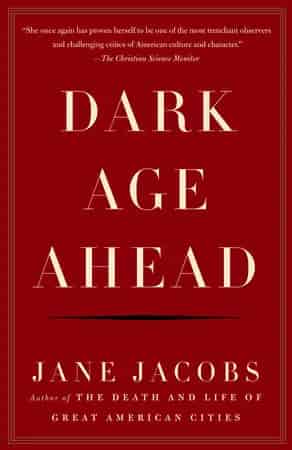
The salient mystery of Dark Ages sets the stage for mass amnesia. People living in vigorous cultures typically treasure those cultures and resist any threat to them. How and why can a people so totally discard a formerly vital culture that it becomes vitally lost?
Anthropology is never an exact science; the observer never experiences the same culture as the participant.
In its relation to the reality of daily life, the high culture of the past was many things—opposition and adornment, outcry and resignation. But it was also the appearance of the realm of freedom: the refusal to behave.
p. 71
Society is eliminating the prerogatives and privileges of feudal. aristocratic culture together with its content. The fact that the transcending truths of the fine arts, the aesthetics of life and thought, were accessible only to the few wealthy and educated was the fault of a repressive society. But this fault is not corrected by paperbacks, general education, long-playing records, and the abolition of formal dress in the theater and concert hall. The cultural privileges expressed the injustice of freedom, the contradiction between ideology and reality, the separation of intellectual from material productivity; but they also provided a protected realm in which the tabooed truths could survive in abstract integrity—remote from the society which suppressed them.
p. 64
Man today can do more than the culture heros and half-gods; he has solved many insoluble problems. But he has also betrayed the hope and destroyed the truth which were preserved in the sublimations of higher culture. To be sure, the higher culture was always in contradiction with social reality, and only a privileged minority enjoyed its blessings and represented its ideals. The two antagonistic spheres of society have always coexisted; the higher culture has always been accommodating, while the reality was rarely disturbed by its ideals and its truth. Today's novel feature is the flattening out of the antagonism between culture and social reality through the obliteration of the oppositional, alien, and transcendent elements in the higher culture by virtue of which it constituted another dimension of reality. This liquidation of two-dimensional culture takes place not through the denial and rejection of the “cultural values,” but through their wholesale incorporation into the established order, through their reproduction and display on a massive scale.
p. 56