Quotes about capitalism
65 quotes · 35 authors
Quotes
There is no wilderness where I can hide from these things, there is no haven where I can escape them; though I travel to the ends of the earth, I find the same accursed system — I find that all the fair and noble impulses of humanity, the dreams of poets and the agonies of martyrs, are shackled and bound in the service of organized and predatory Greed! And therefore I cannot rest, I cannot be silent; therefore I cast aside comfort and happiness, health and good repute—and go out into the world and cry out the pain of my spirit!
It was the incarnation of blind insensate Greed. It was a monster devouring with a thousand mouths, trampling with a thousand hoofs: it was the Great Butcher — it was the spirit of Capitalism made flesh. Upon the ocean of commerce it sailed as a pirate ship; it had hoisted the black flag and declared war upon civilization. Bribery and corruption were its everyday methods. In Chicago the city government was simply one of its branch offices.
The working-man was to fix his hopes upon a future life, while his pockets were picked in this one; he was brought up to frugality, humility, obedience—in short to all the pseudo-virtues of capitalism.
It was all so painfully obvious to Jurgis! It was so incomprehensible how a man could fail to see it! Here were all the opportunities of the country, the land, and the buildings upon the land, the railroads, the mines, the factories, and the stores, all in the hands of a few private individuals, called capitalists, for whom the people were obliged to work for wages. The whole balance of what the people produced went to heap up the fortunes of these capitalists, to heap, and heap again, and yet again—and that in spite of the fact that they, and every one about them, lived in unthinkable luxury! And was it not plain that if the people cut off the share of those who merely "owned," the share of those who worked would be much greater?
Congressman Nixon had asked me why, as the son of immigrants who had been treated so well by Americans, as a man who had been treated like a son and been sent to Harvard by an American capitalist, I had been so ungrateful to the American economic system.
The answer I gave him was not original. Nothing about me has ever been original. I repeated what my one-time hero, Kenneth Whistler, had said in reply to the same general sort of question long, long ago. Whistler had been a witness at a trial of strikers accused of violence. The judge had become curious about him, had asked him why such a well-educated man from such a good family would so immerse himself in the working class.
My stolen answer to Nixon was this: "Why? The Sermon on the Mount, sir."
Rumfoord had known that Constant would try to debase the picture by using it in commerce. Constant's father had done a similar thing when he found he could not buy Leonardo's "Mona Lisa" at any price. The old man had punished Mona Lisa by having her used in an advertising campaign for suppositories. It was the free-enterprise way of handling beauty that threatened to get the upper hand.
p. 56
I disagree with the followers of Marx and those of Adam Smith: the reason free markets work is because they allow people to be lucky, thanks to aggressive trial and error, not by giving rewards or "incentives" for skill.
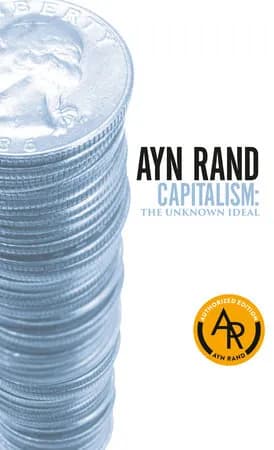
Every coercive monopoly was created by government intervention into the economy: by special privileges, such as franchises or subsidies, which closed the entry of competitors into a given field, by legislative action.
Let anyone who believes that a high standard of living is the achievement of labor unions and government controls ask himself the following question: If one had a "time machine" and transported the united labor chieftains of America, plus three million government bureaucrats, back to the tenth century—would they be able to provide the medieval serf with electric light, refrigerators, automobiles, and television sets?
Capitalism is the only system where such men are free to function and where progress is accompanied, not by forced privations, but by a constant rise in the general level of prosperity, of consumption and of enjoyment of life.
America's abundance was created not by public sacrifices to the common good, but by the productive genius of free men who pursued their own personal interests and the making of their own private fortunes. They did not starve the people to pay for America's industrialization. They gave the people better jobs, higher wages, and cheaper goods with every new machine they invented, with every scientific discovery or technological advance- and thus the whole country was moving forward and profiting, not suffering, every step of the way.
Capitalism has created the highest standard of living ever known on earth. The evidence is incontrovertible. The contrast between West and East Berlin is the latest demonstration, like a laboratory experiment for all to see. Yet those who are loudest in proclaiming their desire to eliminate poverty are loudest in denouncing capitalism. Man's well-being is not their goal.