
Shulamith Firestone
Quotes
The myth of childhood has an even greater parallel in the myth of Femininity. Both women and children were considered asexual and thus"purer" than man. Their inferior status was ill-concealed under an elaborate "respect." One didn't discuss serious matters nor did one curse in from of women and children; one didn't openly degrade them, one did it behind their backs.
p. 88
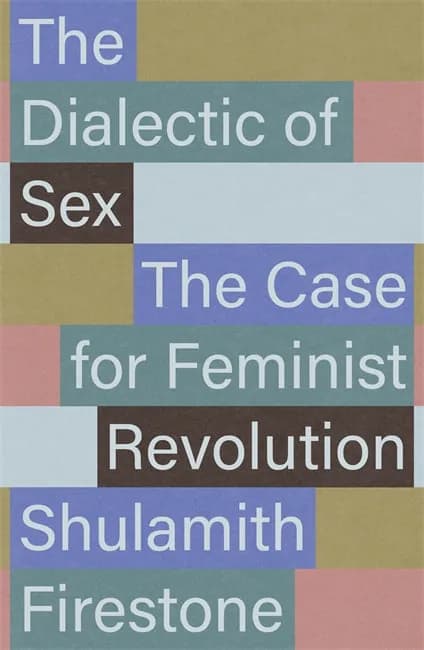 The Dialectic of Sex: The Case for Feminist Revolution
Marriage is in the same state as the Church: both are becoming functionally defunct, as their preachers go about heralding a revival, eagerly chalking up converts in the day of dread. And just as God has been pronounced dead quite often but has this sneaky way of resurrecting himself, so everyone debunks marriage, yet ends up married.
p. 222
The Dialectic of Sex: The Case for Feminist RevolutionThe fact remains: childbirth is at best necessary and tolerable. It is not fun.
p. 199
The Dialectic of Sex: The Case for Feminist RevolutionThere are no precedents in history for feminist revolution – there have been women revolutionaries, certainly, but they have been used by male revolutionaries, who seldom gave even lip service to equality for women, let alone to a radical feminist restructuring of society.
p. 226
The Dialectic of Sex: The Case for Feminist RevolutionA book on radical feminism that did not deal with love would be a political failure. For love, perhaps even more than childbearing, is the pivot of women's oppression today.
The Dialectic of Sex: The Case for Feminist RevolutionCulture then is the sum of, and the dynamic between, the two modes through which the mind attempts to transcend the limitations and contingencies of reality. These two types of cultural responses entail different methods to achieve the same end, the realization of the conceivable in the possible. In the first, the individual denies the limitations of the given reality by escaping from it altogether, to define, create, his own possible. In the provinces of the imagination, objectified in some way – whether through the development of a visual image within some artificial boundary, say four square feet of canvas, through visual images projected through verbal symbols (poetry), with sound ordered into a sequence (music), or with verbal ideas ordered into a progression (theology, philosophy) – he creates an ideal world governed by his own artificially imposed order and harmony, a structure in which he consciously relates each part to the whole, a static (and therefore ‘timeless’) construction. The degree to which he abstracts his creation from reality is unimportant, for even when he most appears to imitate, he has created an illusion governed by its own – perhaps hidden – set of artificial laws. (Degas said that the artist had to lie in order to tell the truth.) This search for the ideal, realized by means of an artificial medium, we shall call the Aesthetic Mode.
p. 173
The Dialectic of Sex: The Case for Feminist RevolutionIn the Middle Ages there was no such thing as childhood. The medieval view of children was profoundly different from ours.
p. 76
The Dialectic of Sex: The Case for Feminist RevolutionRevolutionary feminism is the only radical programme that immediately cracks through to the emotional strata underlying ‘serious’ politics, thus reintegrating the personal with the public, the subjective with the objective, the emotional with the rational – the female principle with the male.
p. 210
The Dialectic of Sex: The Case for Feminist RevolutionAs was demonstrated in the case of the development of atomic energy, radicals, rather than breast-beating about the immorality of scientific research, could be much more effective by concentrating their full energies on demands for control of scientific discoveries by and for the people. For, like atomic energy, fertility control, artificial reproduction, cybernation, in themselves, are liberating – unless they are improperly used.
p. 196
The Dialectic of Sex: The Case for Feminist RevolutionThe beauty ideal. Every society has promoted a certain ideal of beauty over all others. What that ideal is is unimportant, for any ideal leaves the majority out; ideals, by definition, are modelled on rare qualities.
p. 151
The Dialectic of Sex: The Case for Feminist RevolutionTo live without love in the end proves intolerable to men just as it does to women.
p. 137
The Dialectic of Sex: The Case for Feminist RevolutionRadical goals must be kept in sight at all times.
p. 206
The Dialectic of Sex: The Case for Feminist Revolution
