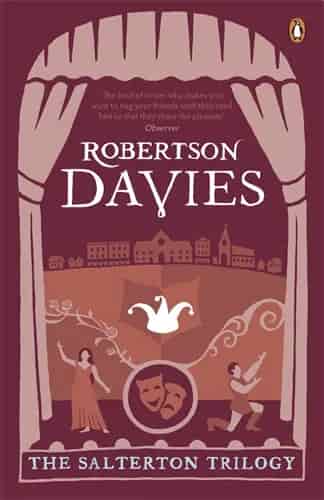
I am increasingly reminded of Oedipus. Do you not recall that in that tragic history, Oedipus met a Sphinx… — Robertson Davies
I am increasingly reminded of Oedipus. Do you not recall that in that tragic history, Oedipus met a Sphinx? The Sphinx spoke in riddles -- very terrible riddles, for those who could not guess them died. But Oedipus guessed the riddle, and the chagrin of the Sphinx was so great that it destroyed itself. I am but a poor shadow of Oedipus, I fear, and you, Mr. Yarrow, but a puny kitten of a Sphinx. But you are, like many another Sphinx of our modern world, an under-educated, brassy young pup, who thinks that gall can take the place of the authority of wisdom, and that a professional lingo can disguise his lack of thought. You aspire to be a Sphinx, without first putting yourself to the labour of acquiring a secret.
Source: Wikiquote · CC BY-SA 4.0

More from this book
People who talk a lot about their troubles never commit suicide; talk's the greatest safety-valve there is. I always laugh at that bit in Hamlet where he pretends to despise himself because he unpacks his heart with words, and falls a-scolding like a very drab; that's why the soliloquy about suicide is just Hamlet putting on intellectual airs. A chatterbox like that would never pop himself off with a bare bodkin. No, the suicides are the quiet ones, who can't find the words to fit their misery.
Pretence is wonderfully stimulating to the artistic mind, which is why some people lie for fun, rather than from necessity.
But the character of the music emphasized the tale as allegory - humorous, poignant, humane allegory - disclosing the metamorphosis of life itself, in which man moves from confident inexperience through the bitterness of experience, toward the rueful wisdom of self-knowledge.