
Quotes
A malfunction of this type can be cured only by changing the nature of the universe, which is, of course, impractical.
p. 34
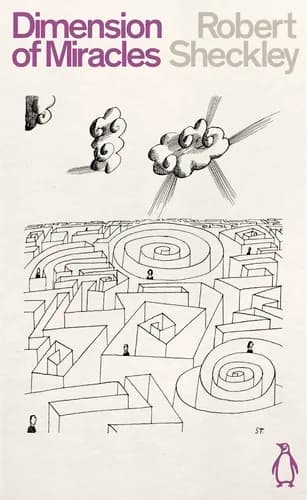
 Dimension of Miracles
Remember, similitude need not imply exactitude.
p. 159
Dimension of MiraclesThe only thing to think over was Me, of course. And the real problem about Me was, What was I supposed to do? Was I meant to be nothing but God? I had tried the God business and found it too limited. It was a job for a simple-minded egomaniac. There had to be something else for me to do—something more meaningful, more expressive of my true self. I’m convinced of it! That is my problem, and that is the question I ask of you: What am I to do with myself?
p. 53
Dimension of Miracles“Isn’t there anything you can do about the predator?” Carmody asked.
“Nothing. Nor would I if I could. Predation is a necessary circumstance. Even the Gods are eventually eaten by Fate. You will not be an exception to the universal rule.”
p. 136
Dimension of MiraclesI’ll follow the reedy tenor of his excuses and blast them with the bellowy bass of irrefutable logic!
p. 33
Dimension of Miracles“You want me to tell you why reality is the way it is,” Seethwright said. “But there is no explanation for that. You must simply learn to fit your preconceptions to what you find. You must not expect reality to adapt itself to you, except very infrequently.
p. 133
Dimension of Miracles“It is the principle of Business, which is more fundamental than the law of gravity. Wherever you go in the galaxy, you can find a food business, a housebuilding business, a war business, a peace business, a governing business, and so forth. And, of course, a God business, which is called ‘religion,’ and which is a particularly reprehensible line of endeavor. I could talk for a year on the perverse and nasty notions that the religions sell, but I’m sure you’ve heard it all before. But I’ll just mention one matter, which seems to underlie everything the religions preach, and which seems to me almost exquisitely perverse.”
“What’s that?” Carmody asked.
“It’s the deep, fundamental bedrock of hypocrisy upon which religion is founded. Consider: no creature can be said to worship if it does not possess free will. Free will, however, is free. And just by virtue of being free, is intractable and incalculable, a truly Godlike gift, the faculty that makes a state of freedom possible. To exist in a state of freedom is a wild, strange thing, and was clearly intended as such. But what do the religions do with this? They say, ‘Very well, you possess free will; but now you must use your free will to enslave yourself to God and to us.’ The effrontery of it! God, who would not coerce a fly, is painted as a supreme slavemaster! In the face of this, any creature with spirit must rebel, must serve God entirely of his own will and volition, or must not serve him at all, thus remaining true to himself and to the faculties God has given him.”
“I think I see what you mean,” Carmody said.
“I’ve made it too complicated,” Maudsley said. “There’s a much simpler reason for avoiding religion.”
“What’s that?”
“Just consider its style—bombastic, hortatory, sickly-sweet, patronizing, artificial, inapropos, boring, filled with dreary images or peppy slogans—fit subject matter for senile old women and unweaned babies, but for no one else. I cannot believe that the God I met here would ever enter a church; he had too much taste and ferocity, too much anger and pride. I can’t believe it, and for me that ends the matter. Why should I go to a place that a God would not enter?”
p. 88
Dimension of MiraclesHow nicely you put it! We may rant against fortune and the world, but we are left at the end with the stark proposition: “These are the things which are.”
p. 108
Dimension of MiraclesOnce upon a time men resisted the implications of actuality. That day is gone. We know now that art is the thing itself together with its extensions into superfluity. Not pop art, I hasten to say, which sneers and exaggerates. This is popular art, which simply exists. This is the age in which we unconditionally accept the unacceptable, and thus proclaim the naturalness of our artificiality.”
p. 187
Dimension of MiraclesA little prescience goes a long way, especially in a galaxy as disorganized as this one.
p. 34
Dimension of Miracles“Well, no sense crying over unspilt blood,” the Prize Clerk said. “If we took full account of our eventualities, we’d soon run out of eventualities for us to take full account of.”
p. 23
Dimension of MiraclesCarmody’s jaw stiffened and he withdrew his hand. He had been pushed around long enough. Now, for the sake of his own self-esteem, he would not yield any more.
p. 31
Dimension of Miracles“Your predator is close behind you and will infallibly be your death.”
“I don’t doubt it,” Carmody said, in a moment of strange calm.” But in terms of long-range planning, I never did expect to get out of this Universe alive.”
“That is meaningless,” the Prize said. “The fact is, you have lost everything.”
“I don’t agree,” Carmody said. “Permit me to point out that I am presently still alive.”
“Agreed. But only for the moment.”
“I have always been alive only for the moment,” Carmody said. “I could never count on more. It was my error to expect more. That holds true, I believe, for all of my possible and potential circumstances.”
“Then what do you hope to achieve with your moment?”
“Nothing,” Carmody said. “Everything.”
“I don’t understand you any longer,” the Prize said. “Something about you has changed, Carmody. What is it?”
“A minor thing,” Carmody told him. “I have simply given up a longevity which I never possessed anyhow. I have turned away from the con game which the Gods run in their heavenly sideshow. I no longer care under which shell the pea of immortality might be found. I don’t need it. I have my moment, which is quite enough.”
“Saint Carmody,” the Prize said, in tones of deepest sarcasm. “No more than a shadow’s breadth separates you and death! What will you do now with your pitiable moment?”
“I shall continue to live it,” Carmody said. “That is what moments are for.”
p. 189
Dimension of Miracles“Earth, Earth,” the short, alien Carmody mused. “I think I remember the name now. There was a recent study of isolated worlds and the peculiarities of their development. Earth was mentioned as a planet covered with an obsessively overproductive species. Object manipulation is their outstanding modality. Their project is an attempt to live in their own, ever-accumulating waste products. In short, Earth is diseased place. I believe it is being phased out of the Galactic Master Plan on the basis of chronic cosmic incompatibility. The place will then be rehabilitated and turned into a refuge for daffodils.”
p. 29
Dimension of MiraclesHe shared the common human hallmark: he was simultaneously predictable and unfathomable—a routine miracle.
p. 14
Dimension of Miracles“Machines!” the Clerk said scornfully. “We have many of them, some exquisitely complex. But event the best of them are much like idiot savants. They do adequately on tedious straightforward tasks like building stars or destroying planets. But give them something tough, like solacing a widow, and they simply go to pieces. Would you believe it, the largest computer in our section can landscape an entire planet; but it cannot fry an egg or carry a tune, and it knows less about ethics than a newborn wolf cub. Would you want something like that to run your life?”
“Of course not,” Carmody said. “But couldn’t someone build a machine with creativity and judgment?”
“Someone has,” the Clerk said. “It has been designed to learn from experience, which means that it must make errors in order to arrive at truths. It comes in many shapes and sizes, most of them quite portable. Its flaws are readily apparent, but seem to exist as necessary counterweights to it virtues. No one has yet improved on the basic design, though many have tried. This ingenious device is called ‘intelligent life.’”
p. 25
Dimension of Miracles
That’s all the quotes.
16 quotes in the collection · come back when we add more