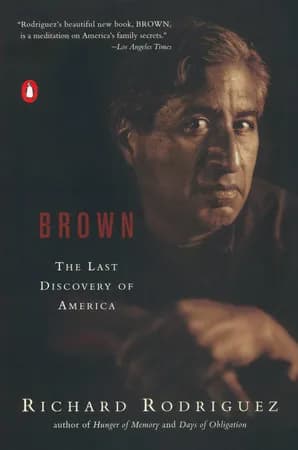
Richard Rodriguez
Quotes
The boy who dreamed his escape on a train whistle floating east, ended up in a gated New Jersey suburb redrawing the map of the world. The world was his last invention. Odd that this self-made man who spent so much time with his long nose to the grindstone would evolve into the global seer, scholar of the world, statesman, not least a politician who wrote his own books. In a late interview, Frank Gannon asked Nixon if he believed he had lived a “good life.” Nixon replied, “I don’t get into that kind of crap.” But what did he truly think in the end? His fall was as precipitous as any in American history.
After all that Richard Nixon had written about how hard work wins the day in America, finally it was Nixon who arranged for me to bypass the old rules. Through the agency of affirmative action, akin to those pivotal narrative devices in Victorian fictions, I had, suddenly, a powerful father in America, like Old Man Kennedy. I had, in short, found a way to cheat. The saddest part of the story is that Nixon was willing to disown his own myth for political expediency. It would be the working-class white kid—the sort he had been—who would end up paying the price of affirmative action, not Kennedys. Affirmative action defined a “minority” in a numerical rather than a cultural sense. And since white males were already numerically “represented” in the boardroom, as at Harvard, the Appalachian white kid could not qualify as a minority. And since brown and black faces were “underrepresented,” those least disadvantaged brown and black Americans, like me, were able to claim the prize of admission and no one questioned our progress.
Dissembling was the specialty of Broadway musicals. The storylines were scrupulously heterosexual. What could I have heard in them that made me think they explained me? It was this: The innocent characters were so wonderfully compromised by the actors who played them; by the writers and musicians who created them. The scar tissue on voices. The makeup on faces. Youth! The wicked stage! The jaded legend refreshed the innocence of my youth. Musical comedy songs were more real than my life because they were articulate and because they had ligaments of narrative attached to them. For today’s young queers and lonelys, these songs must seem quaint and campy and not useful. But they were never campy for me—for us?—they only became camp in the attempt to share them without embarrassment.
Thud. My eyes are open. It is four-thirty in the morning, one morning, and my dry eyes click in their sockets, awake before the birds. There is no light. The eye strains for logic, some play of form. I have been dreaming of wind. The tree outside my window stands silent. I listen to the breathing of the man lying beside me. I know where I am. I am awake. I am alive. Am I tethered to earth only by this fragile breath? A strawful of breath at best. Yet this is the breath that patients beg, their hands gripping the edges of mattresses; this is the breath that wrestles trees, that brings down all the leaves in the Third Act. We know where the car is parked. We know, word-for-word, the texts of plays. We have spoken, in proximity to one another, over years, sentences, hundreds of thousands of sentences—bright, grave, fallible, comic, perishable—perhaps eternal? I don’t know. Where does the wind go? When will the light come? We will have hotcakes for breakfast. How can I protect this . . . ? My church teaches me I cannot. And I believe it. I turn the pillow to its cool side. Then rage fills me, against the cubist necessity of having to arrange myself comically against orthodoxy, against having to wonder if I will offend, against theology that devises that my feeling for him, more than for myself, is a vanity. My brown paradox: The church that taught me to understand love, the church that taught me well to believe love breathes—also tells me it is not love I feel, at four in the morning, in the dark, even before the birds cry. Of every hue and caste am I.
A question about the authenticity of the soul, I suppose. Or the wishbone—some little tug-of-war; some tension. The tension I have come to depend upon. That is what I mean by brown. The answer is that I cannot reconcile. I was born a Catholic. Is homosexuality, then, a conversion experience? No. I was born gay. Is Catholicism ever a choice? Yes. No. Not at first. I embraced Catholicism without question. It was the air, it was the light. Years later, I came to Catholicism in deliberation, defeat—satirically, perhaps—nevertheless on my knees. How else to approach a church established for losers, for a kingdom not of this world, a kingdom of fools? Whatever faith I confess is based upon my certainty that I can do nothing.
In the first televised presidential debate, Nixon thought he was upholding some puritan gravitas by refusing makeup; by choosing the citizen’s black suit; choosing the poor man’s version of natural aristocracy. Nixon was easily the more able in his grasp of history and the workings of government. John F. Kennedy, gold-dusted and ghostwritten, appeared completely natural. Nixon perspired. In an instant, I saw what many other Americans saw that night: Harvard College will always beat Whittier College in America. The game is fixed and there is nothing to be done about it.
I was made an example of—by that woman from the Threepenny Review as the sort of writer, the callow, who parades his education. I use literary allusion as a way of showing off, proof that I have mastered a white idiom, but do not have the confidence of it.
Americans are so individualistic, they do not realize their individualism is a communally derived value. The American I is deconstructed for me by Paolo, an architect who was raised in Bologna: "You Americans are not truly individualistic, you merely are lonely. In order to be individualistic, one must have a strong sense of oneself within a group." (The "we" is a precondition for saying "I.") Americans spend all their lives looking for a community: a chatroom, a church, a support group, a fetish magazine, a book club, a class action suit... illusions become real when we think they are real and act accordingly. Because Americans thought themselves free of plural pronouns, they began to act as free agents, thus to recreate history. Individuals drifted away from tribe or color or 'hood or hometown or card of explanation, where everyone knew who they were... Americans thus extended the American community by acting so individualistically, so anonymously.
My father died of neither hot nor cold. My father was as leathern as a saint. He required no trees. As unrefreshed as a Muslim courtyard. He required no fountain. No music. Whenever he saw a baby he said “poor baby.” His questions were the basic questions, as prosaic as footsteps. What is heaven like? Will I be young? Will I be with Mama? Will I go to sleep? (I don’t know, Papa; how can I know?) Absurdly, I gave answers.
As a young man, I was more a white liberal than I ever tried to put on black. For all that, I ended up a “minority,” the beneficiary of affirmative action programs to redress black exclusion. And, harder to say, my brown advantage became a kind of embarrassment. For I never had an adversarial relationship to American culture. I was never at war with the tongue. Brown was no longer invisible by the time I got to college. In the white appraisal, brown skin became a coat of disadvantage, which was my advantage. Acknowledgment came at a price, then as now. (Three decades later, the price of being a published brown author is that one cannot be shelved near those one has loved. The price is segregation.) I remain at best ambivalent about those Hispanic anthologies where I end up; about those anthologies where I end up the Hispanic; about shelves at the bookstore where I look for myself and find myself. The fact that my books are published at all is the result of the slaphappy strategy of the northern black Civil Rights movement.
But middle-class Americans, friends of mine, composites of friends of mine, of a liberal bent, nice people, OK people, see nothing wrong with bilingual education. In fact, they wish their own children to be bilingual. In fact, they send their kids to French schools. In fact, they ask if I know of a housekeeper who might inadvertently teach their children Spanish while she dusts under the piano. Nope.
I DON’T KNOW IF YOU HAVE EVER LUNCHED WITH A VEGETARIAN. Probably you have. If you live in San Francisco you have. Then you’ve seen Dominic, his hand raised, fingers slightly crook’d to summon a waitress: Ma’am? (Pointing to the menu.) Is this dish made with meat stock? The waitress (a Chinese restaurant) takes a moment to divine the desired answer. No. (When in doubt.) So imperial, so sliding scale, so uncomprehending is her no, so wise is her no, finally, so Greek, so Arab, so Catholic, so Brown is her no, Dominic cannot be reassured. Dominic’s vegetarianism has to do with upholding the sacredness of life. He needs a puritan answer. Whereas Peter. Peter is the son of my friend Franz. Peter is as easy in the brown world of maybe as he is in his own white skin. He is wandering through India as I write this. Peter is handsome, gentle, Hindu-intoxicated, slightly blue; his skin is slightly blue. Peter’s veganism has to do with the sacredness of his own body; with the purity of his lungs and his bowels and his liver and his breath. Peter’s vigilance is maniacal: Do you place meat and vegetables on the same grill?