Leafy Quotes
Recently added
The newest book quotes in the Leafy Quotes collection — passages readers have just added, each with its author, book and the page it came from.
Writing is a long and lonesome business; back of the problems in thought and composition hover always the awful questions: Is this the page that shows the empty shell? Is it here and now that they find me out?
A banker need not be popular; indeed a good banker in a healthy capitalist society should probably be much disliked. People do not wish to trust their money to a hail-fellow-well-met but to a misanthrope who can say no.
p. 115
Men meet together for many reasons in the course of business. They need to instruct or persuade each other. They must agree on a course of action. They find thinking in public more productive or less painful than thinking in private. But there are at least as many reasons for meetings to transact no business. Meetings are held because men seek companionship or, at a minimum, wish to escape the tedium of solitary duties. They yearn for the prestige which accrues to the man who presides over meetings, and this leads them to convoke assemblages over which they can preside. Finally, there is the meeting which is called not because there is business to be done, but because it is necessary to create the impression that business is being done. Such meetings are more than a substitute for action. They are widely regarded as action.
p. 139
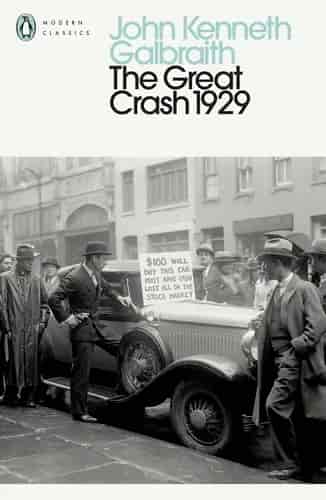
Of all the mysteries of the stock exchange there is none so impenetrable as why there should be a buyer for everyone who seeks to sell.
One of the uses of depression is the exposure of what auditors fail to find.
p. 135
Of all the weapons in the Federal Reserve arsenal, words were the most unpredictable in their consequences.
The advisers and counselors were not, however, analyzing the danger or even the possibility. They were serving only as the custodians of bad memories.
p. 184
Wall Street's crime, in the eyes of its classical enemies, was less its power than its morals.
p. 155
Despite a flattering supposition to the contrary, people come readily to terms with power. There is little reason to think that the power of the great bankers, while they were assumed to have it, was much resented. But as the ghosts of numerous tyrants, from Julius Caesar to Benito Mussolini will testify, people are very hard on those who, having had power, lose it or are destroyed. Then anger at past arrogance is joined with contempt for the present weakness. The victim or his corpse is made to suffer all available indignities.
p. 115
The values of a society totally preoccupied with making money are not altogether reassuring.
Our political tradition sets great store by the generalized symbol of evil. This is the wrongdoer whose wrongdoing will be taken by the public to be the secret propensity of a whole community or class.
p. 154
It was not hard to persuade people that the market was sound; as always in such times they asked only that the disturbing voices of doubt be muted and that there be tolerably frequent expressions of confidence.