Leafy Quotes
Recently added
The newest book quotes in the Leafy Quotes collection — passages readers have just added, each with its author, book and the page it came from.
On the whole, more men had perhaps escaped into the war than from it.
In some mysterious way, once one has gained an insight into human nature, that insight grows from day to day, and he to whom it has given to experience vicariously even one single form of earthly suffering acquires, by reason of this tragic lesson, an understanding of all its forms, even those most foreign to him, and apparently abnormal.
Everywhere soldiering entails the same busily empty monotony; hour after hour is mapped out in accordance with inflexible, antediluvian regulations, and even one's leisure does not seem to offer much in the way of variety. In the officers' mess the same faces, the same conversation; at the cafe the same games of cards and billiards.
There are two kinds of pity. One, the weak and sentimental kind, which is really no more than the heart's impatience to be rid as quickly as possible of the painful emotion aroused by the sight of another's unhappiness, that pity which is not compassion, but only an instinctive desire to fortify one's own soul against the sufferings of another; and the other, the only one at counts, the unsentimental but creative kind, which knows what it is about and is determined to hold out, in patience and forbearance, to the very limit of its strength and even beyond.
Long-protracted suffering is apt to exhaust not only the invalid, but the compassion of others; violent emotions cannot be prolonged endlessly.
It is never until one realizes that one means something to others that one feels there is any point or purpose in one's own existence.
Inevitably, in the secret chemistry of the emotions the feeling of pity for a sick person is imperceptibly bound up with tenderness.
It always demands a far greater degree of courage for an individual to oppose an organized movement than to let himself be carried along with the stream — individual courage, that is, a variety of courage that is dying out in these times of progressive organization and mechanization. During the war practically the only courage I ran across was mass courage, the courage that comes of being one of a herd, and anyone who examines this phenomenon more closely will find it to be compounded of some very strange elements: a great deal of vanity, a great deal of fear — yes, fear of staying behind, fear of being sneered at fear of independent action, and fear, above all, of taking up a stand against the mass enthusiasm of one's fellows.
Unhappiness makes people vulnerable, incessant suffering unjust. Just as in the relations between a creditor and a debtor there is always an element of the disagreeable that can never be overcome, for the very reason that the one is irrevocably committed to the role of giver and the other to that of receiver, so in a sick person a latent feeling of resentment at every obvious sign of consideration is always ready to burst forth.
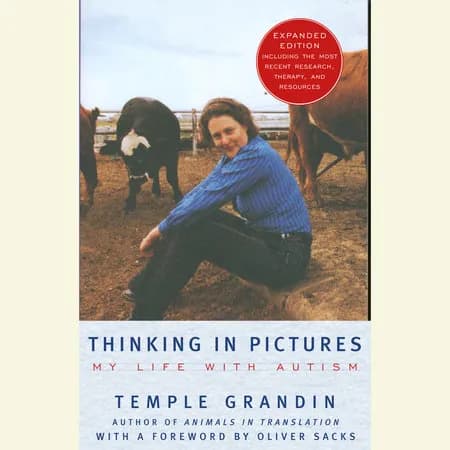
The possibility that a void exists after death has motivated me to work hard so I can make a difference — so that my thoughts and ideas will not die. When I was working on my Ph.D., a coworker in our lab told me that the world's libraries contain our extra soma, or out-of-body genes. Ideas are passed on like genes, and I have a great urge to spread my ideas. I read an article in the newspaper about an official at the New York Public Library who said that the only place on earth where immortality is provided is in libraries. This is the collective memory of humanity. I put this on a sign and placed it over my desk. It helped me to persevere and get through my Ph.D. work. (p199)
Problems that autistic people have with eye contact and awkward gestures are not visible on the Internet, and typewritten messages avoid many of the social problems of face-to-face contact. The Internet may be the best thing yet for improving an autistic person's social life. (p100)
Quantum uncertainty, chaos—these forever screen precise knowledge of the future from our eyes.
p. 386