Leafy Quotes
Recently added
The newest book quotes in the Leafy Quotes collection — passages readers have just added, each with its author, book and the page it came from.
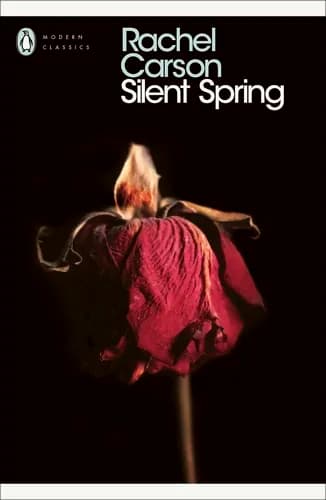
The history of life on earth has been a history of interaction between living things and their surroundings. To a large extent, the physical form and the habits of the earth's vegetation and its animal life have been molded by the environment. Considering the whole span of earthly time, the opposite effect, in which life actually modifies its surroundings, has been relatively slight. Only within the moment of time represented by the present century has one species-man-acquired significant power to alter the nature of his world.
We stand now where two roads diverge. But unlike the roads in Robert Frost's familiar poem, they are not equally fair. The road we have long been traveling is deceptively easy, a smooth superhighway on which we progress with great speed, but at its end lies disaster. The other fork of the road-the one "less traveled by"-offers our last, our only chance to reach a destination that assures the preservation of our earth. The choice, after all, is ours to make.
p. 277
This is an era of specialists, each of whom sees his own problem and is unaware of or intolerant of the larger frame into which it fits.
p. 13
Future generations are unlikely to condone our lack of prudent concern for the integrity of the natural world that supports all life.
Much of the necessary knowledge is now available but we do not use it. We train ecologists in our universities and even employ them in our governmental agencies but we seldom take their advice. We allow the chemical death rain to fall as though there were no alternative, whereas in fact there are many, and our ingenuity could soon discover many more if given opportunity.
Given time-time not in years but in millennia-life adjusts, and a balance has been reached. For time is the essential ingredient; but in the modern world there is no time.
In our own lifetime we are witnessing a startling alteration of climate.
It is one of the great ironies of corporate control that the corporate state needs the abilities of intellectuals to maintain power, yet outside of this role it refuses to permit intellectuals to think or function independently.
Day by day and season by season, the ocean dominates the world's climate.
The figure is staggering and its implications are not easily grasped-500 new chemicals to which the bodies of men and animals are required somehow to adapt each year, chemicals totally outside the limits of biologic experience.
Have we fallen into a mesmerized state that makes us accept as inevitable that which is inferior or detrimental, as though having lost the will or the vision to demand that which is good?
It is an era dominated by industry, in which the right to make a dollar at whatever cost is seldom challenged. When the public protests, confronted with some obvious evidence of damaging results of pesticide applications, it is fed little tranquilizing pills of half truth. We urgently need an end to these false assurances, to the sugar coating of unpalatable facts. It is the public that is being asked to assume the risks that the insect controllers calculate. The public must decide whether it wishes to continue on the present road, and it can do so only when in full possession of the facts.