Leafy Quotes
Recently added
The newest book quotes in the Leafy Quotes collection — passages readers have just added, each with its author, book and the page it came from.
Human beings cannot endure emptiness and desolation; they will fill the vacuum by creating a new focus of meaning. The idols of fundamentalism are not good substitutes for God; if we are to create a vibrant new faith for the twenty-first century, we should, perhaps, ponder the history of God for some lessons and warnings.
Yet a personal God can become a grave liability. He can be a mere idol carved in our own image, a projection of our limited needs, fears and desires. We can assume that he loves what we love and hates what we hate, endorsing our prejudices instead of compelling us to transcend them.
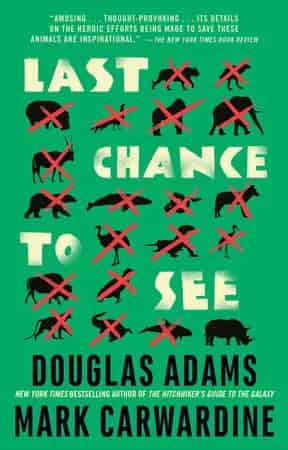
[On the kakapo’s tendency to freeze in confusion when faced with a predator:] It’s frustrating to think of the difference that language would make. The millennia crawl by pretty bloody slowly while natural selection sifts its way through generation after generation, favouring the odd aberrant kakapo, which is a little twitchier than its contemporaries, till the species as a whole finally gets the idea. It would all be cut short in a moment if one of them could say, “When you see one of those things with whiskers and little bitey teeth, run like hell.” On the other hand, human beings, who are almost unique in having the ability to learn from the experience of others, are also remarkable for their apparent disinclination to do so.
p. 116
I have a well-deserved reputation for being something of a gadget freak, and am rarely happier than when spending an entire day programming my computer to perform automatically a task that it would otherwise take me a good ten seconds to do by hand.
p. 38
I was feeling pretty raw about my own species because we presume to draw a distinction between what we call good and what we call evil. We find our images of what we call evil in things outside ourselves, in creatures that know nothing of such matters, so that we can feel revolted by them, and, by contrast, good about ourselves.
p. 48
It bothers me when they make up these colourful answers. I wish I could make them understand that if they don’t know the answer, or they think the right answer isn’t very interesting, it’s better to say so rather than just invent absolute nonsense.
p. 76
I remembered once, in Japan, having been to see the Gold Pavilion Temple in Kyoto and being mildly surprised at quite how well it had weathered the passage of time since it was first built in the fourteenth century. I was told it hadn’t weathered well at all, and had in fact been burnt to the ground twice in this century.
“So it isn’t the original building?” I had asked my Japanese guide.
“But yes, of course it is,” he insisted, rather surprised at my question.
“But it’s been burned down?”
“Yes.”
“Twice.”
“Many times.”
“And rebuilt.”
“Of course. It is an important and historic building.”
“With completely new materials.”
“But of course. It was burned down.”
“So how can it be the same building?”
“It is always the same building.”
I had to admit to myself that this was in fact a perfectly rational point of view, it merely started from an unexpected premise. The idea of the building, the intention of it, its design, are all immutable and are the essence of the building. The intention of the original builders is what survives. The wood of which the design is constructed decays and is replaced when necessary. To be overly concerned with the original materials, which are merely sentimental souvenirs of the past, is to fail to see the living building itself.
I couldn’t feel entirely comfortable with this view, because it fought against my basic Western assumptions, but I did see the point.
p. 148
We are not an endangered species ourselves yet, but this is not for lack of trying.
p. 68
The great thing about being the only species that makes a distinction between right and wrong is that we can make up the rules for ourselves as we go along.
p. 49
It’s easy to think that as a result of the extinction of the dodo, we are now sadder and wiser, but there’s a lot of evidence to suggest that we are merely sadder and better informed.
p. 205
Wildlife conservation is always a race against time. As zoologists and botanists explore new areas, scrabbling to record the mere existence of species before they become extinct, it is like someone hurrying through a burning library desperately trying to jot down some of the titles of books that will now never be read.
p. 211
The only people who do believe it are people who’ve read somewhere that other people believe it, and are ready and willing to believe anything they hear that they like the sound of.
p. 90