Leafy Quotes
Recently added
The newest book quotes in the Leafy Quotes collection — passages readers have just added, each with its author, book and the page it came from.
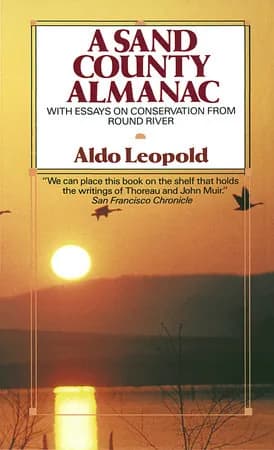
Individual thinkers since the days of Ezekiel and Isaiah have asserted that the despoliation of land is not only inexpedient but wrong. Society, however, has not yet affirmed their belief. I regard the present conservation movement as the embryo of such an affirmation.
p. 203
We all strive for safety, prosperity, comfort, long life, and dullness. The deer strives with his supple legs, the cowman with trap and poison, the statesman with pen, the most of us with machines, votes, and dollars, but it all comes to the same thing: peace in our time. A measure of success in this is all well enough, and perhaps is a requisite to objective thinking, but too much safety seems to yield only danger in the long run. Perhaps this is behind Thoreau’s dictum: In wildness is the salvation of the world. Perhaps this is the hidden meaning in the howl of the wolf, long known among mountains, but seldom perceived among men.
p. 133
Science contributes moral as well as material blessings to the world. Its great moral contribution is objectivity, or the scientific point of view. This means doubting everything except facts; it means hewing to the facts, let the chips fall where they may.
p. 153
Wilderness is the raw material out of which man has hammered the artifact called civilization.
p. 188
Do we not already sing our love for and obligation to the land of the free and the home of the brave? Yes, but just what and whom do we love? Certainly not the soil, which we are sending helter-skelter downriver. Certainly not the waters, which we assume have no function except to turn turbines, float barges, and carry off sewage. Certainly not the plants, of which we exterminate whole communities without batting an eye. Certainly not the animals, of which we have already extirpated many of the largest and most beautiful species.
p. 204
All ethics so far evolved rest upon a single premise: that the individual is a member of a community of interdependent parts. … The land ethic simply enlarges the boundaries of the community to include soils, waters, plants, and animals, or collectively: the land. … A land ethic changes the role of Homo sapiens from conqueror of the land-community to plain member and citizen of it. It implies respect for his fellow-members, and also respect for the community as such.
p. 203
When you control a man's thinking you do not have to worry about his actions. You do not have to tell him not to stand here or go yonder. He will find his "proper place" and will stay in it. You do not need to send him to the back door. He will go without being told. In fact, if there is no back door, he will cut one for his special benefit. His education makes it necessary.
The same educational process which inspires and stimulates the oppressor with the thought that he is everything and has accomplished everything worth while, depresses and crushes at the same time the spark of genius in the Negro by making him feel that his race does not amount to much and never will measure up to the standards of other peoples. The Negro thus educated is a hopeless liability of the race.
p. 21
The drama of the sky dance is enacted nightly on hundreds of farms, the owners of which sigh for entertainment, but harbor the illusion that it is to be sought in theaters. They live on the land, but not by the land.
p. 34
One swallow does not make a summer, but one skein of geese, cleaving the murk of a March thaw, is the spring.
p. 18
I have read many definitions of what is a conservationist, and written not a few myself, but I suspect that the best one is written not with a pen, but with an axe. It is a matter of what a man thinks about while chopping, or while deciding what to chop. A conservationist is one who is humbly aware that with each stroke he is writing his signature on the face of his land.
p. 68
The modern dogma is comfort at any cost.
p. 71
Hunts differ in flavor, but the reasons are subtle. The sweetest hunts are stolen. To steal a hunt, either go far into the wilderness where no one has been, or else find some undiscovered place under everybody’s nose.
p. 55