Leafy Quotes
Recently added
The newest book quotes in the Leafy Quotes collection — passages readers have just added, each with its author, book and the page it came from.
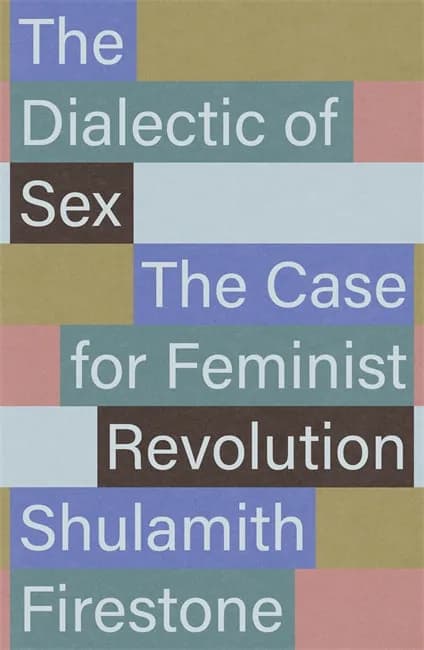
Though the sex class system may have originated in fundamental biological conditions, this does not guarantee once the biological basis of their oppression has been swept away that women and children will be freed.
p. 10
Freudianism has become, with its confessionals and penance, its proselytes and converts, with the millions spent on its upkeep, our modern Church. We attack only uneasily, for you never know, on the day of final judgement, whether might be right. Who can be sure that he is as healthy as he can get? Who is functioning at his highest capacity? And who not scared out of his wis? Who doesn't hate his mother and father? Who doesn't compete with his brother? What girl at some time did not wish she were a boy? And for those hardy souls who persist in their skepticism, there is always that dreadful persist in their skepticism, there is always that dreadful word resistance. They are the one who are sickest: it's obvious, they fight it so much.
p. 42
The means of production being the collective work of humanity, the product should be the collective property of the race. Individual appropriation is neither just nor serviceable. All belongs to all. All things are for all men, since all men have need of them, since all men have worked in the measure of their strength to produce them, and since it is not possible to evaluate every one's part in the production of the world's wealth.
All things are for all. Here is an immense stock of tools and implements; here are all those iron slaves which we call machines, which saw and plane, spin and weave for us, unmaking and remaking, working up raw matter to produce the marvels of our time. But nobody has the right to seize a single one of these machines and say, "This is mine; if you want to use it you must pay me a tax on each of your products," any more than the feudal lord of medieval times had the right to say to the peasant, "This hill, this meadow belong to me, and you must pay me a tax on every sheaf of corn you reap, on every rick you build."
All is for all! If the man and the woman bear their fair share of work, they have a right to their fair share of all that is produced by all, and that share is enough to secure them well-being. No more of such vague formulas as "The Right to work," or "To each the whole result of his labour." What we proclaim is The Right to Well-Being: Well-Being for All!
The landlord owes his riches to the poverty of the peasants, and the wealth of the capitalist comes from the same source.
From the cradle to the grave all our actions are guided by this principle. Open any book on sociology or jurisprudence, and you will find there the Government, its organization, its acts, filling so large a place that we ome to believe that there is nothing outside the Government and the world of statesmen.
p. 79
We are beginning to see that government by majorities means abandoning all the affairs of the country to the tide-waiters who make up the majorities in the House and in election committees; to those, in a word, who have no pinion of their own.
p. 81
The house was not built by its owner. It was erected, decorated, and furnished by innumerable workers — in the timber yard, the brick field, and the workshop, toiling for dear life at a minimum wage.
Accustomed as we are by hereditary prejudices an absolutely unsound education and training to see Government, legislation and magistracy everywhere around, we have come to believe that man would tear his fellow man to pieces like a wild beast the day the police took his eye off him; that chaos would come about if authority were overthrown during a revolution. And with out eyes shut we pass by thousands and thousands of human groupings which form themselves freely, without any intervention of the law, and attain results infinitely superior to those achieved under government tutelage.
That we are Utopians is well known. So Utopian are we that we go the length of believing that the Revolution can and ought to assure shelter, food, and clothes to all — an idea extremely displeasing to middle-class citizens, whatever their party color, for they are quite alive to the fact that it is not easy to keep the upper hand of a people whose hunger is satisfied.
p. 98
Education still remains the privilege of a small minority, for it is idle to talk of education when the workman’s child is forced at the age of thirteen, to go down in to the mine or to help his father on the farm. It is idle to talk of studies to the worker, who comes home in the evening crushed by excessive toil with its brutalizing atmosphere. Society is thus bound to remain divided into two hostile camps, and in such conditions, freedom is a vain word. The Radical begins by demanding a greater extension of political rights, but he soon sees the at breath of liberty leads to the uplifting of the proletariat, and then he turns round, changes his opinions, and reverts to repressive legislation and government by the sword.
p. 60
What we do want is so to arrange things that every human being born into the world shall be ensured the opportunity in the first instance of learning some useful occupation, and of becoming skill in it; next, that he shall be free to work at his trade without asking leave of master or owner, and without handing over to landlord or capitalist the lion's share of what he produces.
We must recognize, and loudly proclaim, that every one, whatever his grade in the old society, whether strong or weak, capable or incapable, as, before everything, THE RIGHT TO LIVE, and that society is bound to share amongst all, without exception , the means of existence at its disposal.
p. 71