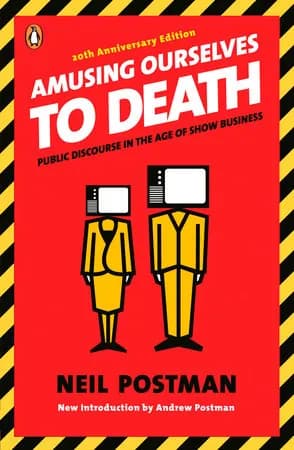
Neil Postman
Quotes
What I am claiming here is not that television is entertaining but that it has made entertainment itself the natural format for the representation of all experience.
p. 87
Technopoly is a state of culture... state of mind... the deification of technology, which means that the culture seeks its authorization in technology... its satisfactions... its orders... This requires the development of a new kind of social order, and of necessity leads to the rapid dissolution of much that is associated with traditional beliefs. Those who feel most comfortable in Technopoly are those who are convinced that technical progress is humanity's superhuman achievement and the instrument by which our most profound dilemmas may be solved. They also believe that information is an unmixed blessing, which through its continued and uncontrolled production and dissemination offers increased freedom, creativity, and peace of mind. The fact that information does none of these things — but quite the opposite — seems to change few opinions, for unwavering beliefs are an inevitable product of the structure of Technopoly. In particular, Technopoly flourishes when the defenses against information break down.
In the United States, we can see such collisions everywhere... but... most clearly in the schools, where two great technologies confront each other in uncompromising aspect for the control of students' minds. On the one hand, there is the world of the printed word with its emphasis on logic, sequence, history, exposition, objectivity, detachment, and discipline. On the other there is the world of television with its emphasis on imagery, narrative, presentness, simultaneity, intimacy, immediate gratification, and quick emotional response. Children come to school having been deeply conditioned by the biases of television. ...children who cannot organize their thought into logical structure even in a simple paragraph, children who cannot attend to lectures or oral explanations for more than a few minutes at a time... They are failures because there is a media war going on, and they are on the wrong side — at least for the moment.
For even the simplest act of naming a thing is an act of thinking—of comparing one thing with others, selecting certain features in common, ignoring what is different, and making an imaginary category.
p. 72
Voting, we might even say, is the next to last refuge of the politically impotent.
p. 69
In a technocracy, tools play a central role in the thought-world of the culture. Everything must give way, in some degree, to their development. The social and symbolic worlds become increasingly subject to the requirements of that development. Tools are not integrated into the culture; they attack the culture. They bid to become the culture. As a consequence, tradition, social mores, myth, politics, ritual, and religion have to fight for their lives...
Eyeglasses refuted the belief that anatomy is destiny by putting forward the idea that our bodies as well as our minds are improvable.
p. 14
In introducing the personal computer to the classroom, we shall be breaking a four-hundred year-old truce between the gregariousness and openness fostered by orality and the introspection and isolation fostered by the printed word. Orality stresses group learning, cooperation, and a sense of social responsibility... Print stresses individualized learning, competition, and personal autonomy. Over four centuries, teachers, while emphasizing print, have allowed orality its place in the classroom, and have therefore achieved a kind of pedagogical peace between these two forms of learning, so that what is valuable in each can be maximized. Now comes the computer, carrying anew the banner of private learning and individual problem-solving. Will the widespread use of computers in the classroom defeat once and for all the claims of communal speech? Will the computer raise egocentrism to the status of a virtue?
The clearest way to see through a culture is to attend to its tools for conversation.
p. 8
We can imagine that Thamus [or Amun: this is a reference to a discussion on the value of writing in Plato's Phaedrus] would also have pointed out to Gutenberg, as he did to Theuth, that the new invention would create a vast population of readers who "will receive a quantity of information without proper instruction... with the conceit of wisdom instead of real wisdom"; that reading, in other words, will compete with older forms of learning. This is yet another principle of technological change we may infer from the judgment of Thamus: new technologies compete with old ones — for time, for attention, for money, for prestige, but mostly for dominance of their world-view. This competition is implicit once we acknowledge that the medium contains an ideological bias. And it is a fierce competition, as only ideological competitions can be. It is not merely a matter of tool against tool — the alphabet attacking ideographic writing, the printing press attacking the illuminated manuscript, the photograph attacking the art of painting, television attacking the printed word. When media make war against each other, it is a case of world-views in collision.
What Orwell feared were those who would ban books. What Huxley feared was that there would be no reason to ban a book, for there would be no one who wanted to read one. Orwell feared those who would deprive us of information. Huxley feared those who would give us so much that we would be reduced to passivity and egoism. Orwell feared that the truth would be concealed from us. Huxley feared the truth would be drowned in a sea of irrelevance. Orwell feared we would become a captive culture. Huxley feared we would become a trivial culture, preoccupied with some equivalent of the feelies, the orgy porgy, and the centrifugal bumblepuppy. As Huxley remarked in Brave New World Revisited, the civil libertarians and rationalists who are ever on the alert to oppose tyranny "failed to take into account man's almost infinite appetite for distractions". In 1984, Huxley added, people are controlled by inflicting pain. In Brave New World, they are controlled by inflicting pleasure. In short, Orwell feared that what we hate will ruin us. Huxley feared that what we love will ruin us.
Because of what computers commonly do... With the exception of the electric light, there never has been a technology that better exemplifies Marshall McLuhan's aphorism "The medium is the message." …the "message" of computer technology is comprehensive and domineering. The computer argues, to put it baldly, that the most serious problems confronting us at both personal and professional levels require technical solutions through fast access to information otherwise unavailable. ...this is... nonsense. Our most serious problems are not technical, nor do they arise from inadequate information. If a nuclear catastrophe occurs, it shall not be because of inadequate information. Where people are dying of starvation, it does not occur because of inadequate information. If families break up, children are mistreated, crime terrorizes a city, education is impotent, it does not happen because of inadequate information. Mathematical equations, instantaneous communication, and vast quantities of information have nothing whatever to do with any of these problems. And the computer is useless in addressing them.