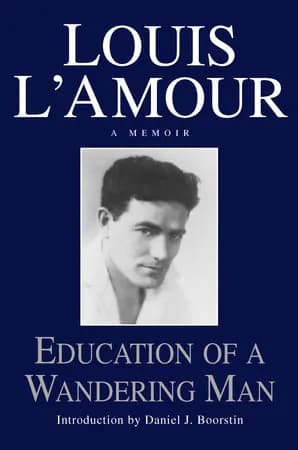
Louis L’Amour
Quotes
Only one who has learned much can fully appreciate his ignorance.
He knows well the limits of his knowledge and how much is waiting to be learned.
My own education, which is the one I know most about, has been haphazard, a hit-and-miss affair that was and continues to be thoroughly delightful.
I came into the world with two priceless advantages: good health and a love of learning. When I left school at the age of fifteen I was halfway through the tenth grade. I left for two reasons, economic necessity being the first of them. More important was that school was interfering with my education.
A mistake constantly made by those who should know better is to judge people of the past by our standards rather than their own. The only way men or women can be judged is against the canvas of their own time.
Once, when hitchhiking, I was picked up by a professor from some small college. He noticed a book in my coat pocket, and was curious. It was a Modern Library edition, in the limp bindings they used to have, which sold at the time for 95 cents. This one contained Nietzsche's Ecce Homo, and The Birth of Tragedy.
The professor was a pedantic man of limited imagination and seemed almost offended that I was reading such a book. Obviously I did not fit some category in which he decided I belonged, and when he dropped me off in town, I suspect he was relived to be rid of me.
He kept asking me why I wanted to read such a book. At first, he doubted I was reading it. Where had I heard of Nietzsche?
When I told him I thought it was in the preface to a book on Schopenhauer, he was even more disturbed and probably believed I was lying. Fortunately, there seem to be few of his kind, and my subsequent friendships with university professors have proved exciting, stimulating and fun.
I would not sit waiting for some vague tomorrow, nor for something to happen. One could wait a lifetime, and find nothing at the end of the waiting. I would begin here, I would make something happen.
The idea of education has been so tied to schools, universities, and professors that many assume that there is no other way, but education is available to anyone within reach of a library, a post office, or even a newsstand.
Today you can buy the Dialogues of Plato for less than you would spend on a fifth of whiskey, or Gibbon's Decline and Fall of the Roman Empire for the price of a cheap shirt. You can buy a fair beginning of any education in any bookstore with a good stock of paperback books for less than you would spend on a week's supply of gasoline.
Often I hear people say they do not have time to read. That's absolute nonsense. In the one year during which I kept that kind of record, I read twenty-five books while waiting for people. In offices, applying for jobs, waiting to see a dentist, waiting in a restaurant for friends, many such places. I read on buses, trains, and planes. If one really wants to learn, one has to decide what is important. Spending an evening on the town? Attending a ball game? Or learning something that can be with you your life long?
How much of what we do is free will, and how much is programmed in our genes? Why is each people so narrow that it believes that it, and it alone, has all the answers?
In religion, is there but one road to salvation? Or are there many, all equally good, all going in the same general direction?
I have read my books by many lights, hoarding their beauty, their wit or wisdom against the dark days when I would have no book, nor a place to read. I have known hunger of the belly kind many times over, but I have known a worse hunger: the need to know and to learn.
As can be guessed from the title, this book is about education, but not education in the accepted sense. No man or woman had a greater appreciation for schools than I, although few have spent less time in them. No matter how much I admire our schools, I know that no university exists that can provide an education; what a university can provide is an outline, to give the learner a direction and guidance. The rest one has to do for oneself.
If I were asked what education should give, I would say it should offer a breadth of view, ease of understanding, tolerance for others, and a background from which the mind can explore in any direction.
Education should provide the tools for widening and deepening of life, for increased appreciation of all one sees or experiences. It should equip a person to live life well, to understand what is happening about him, for to live life well one must live with awarenes.
No one can get an education, for of necessity education is a continuing process. If it does nothing else, it should provide students with the tools for learning, acquaint them with the methods of study and research, methods of pursuing and idea. We can only hope they come upon an issue they wish to pursue.
A great book begins with an idea; a great life, with a determination.
My life may not be great to others, but to me it has been one of steady progression, never dull, often exciting, often hungry, tired, and lonely, but always learning. Somewhere back down the years I decided, or my nature decided for me, that I would be a teller of stories.
Decisions had to be made and there was nobody but me to make them. My course altered a number of times but never deviated from the destination I had decided upon. Whether this was altogether a matter of choice I do not know. Perhaps my early reading and the storytelling at home had preconditioned me for the role I adopted.
Somewhere along the line I had fallen in love with learning, and it became a lifelong romance. Early on I discovered it was fun to follow along the byways of history to find those treasures that await any searcher. It may be that all later decisions followed naturally from that first one.
One thing has always been true: That book or that person who can give me an idea or a new slant on an old idea is my friend.
'''It is often said that one has but one life to live, but that is nonsense. For one who reads, there is no limit to the number of lives that may be lived, for fiction, biography, and history offer an inexhaustible number of lives in many parts of the world, in all periods of time.
We are all of us, it has been said, the children of immigrants and foreigners — even the American Indian, although he arrived here a little earlier. What a man is and what he becomes is in part due to his heritage, and the men and women who came west did not emerge suddenly from limbo. Behind them were ancestors, families, and former lives. Yet even as the domestic cattle of Europe evolved into the wild longhorns of Texas, so the American pioneer had the characteristics of a distinctive type.
Physically and psychologically, the pioneers' need for change had begun in the old countries with their decision to migrate. In most cases their decisions were personal, ordered by no one else. Even when migration was ordered or forced, the people who survived were characterized by physical strength, the capacity to endure, and not uncommonly, a rebellious nature.
History is not made only by kings and parliaments, presidents, wars, and generals. It is the story of people, of their love, honor, faith, hope and suffering; of birth and death, of hunger, thirst and cold, of loneliness and sorrow. In writing my stories I have found myself looking back again and again to origins, to find and clearly see the ancestors of the pioneers.
Out here you better have a gun, and a gun in the wagon ain't good for nothin'. I believe what the old Quaker said,"Trust in the Lord, but keep your powder dry."