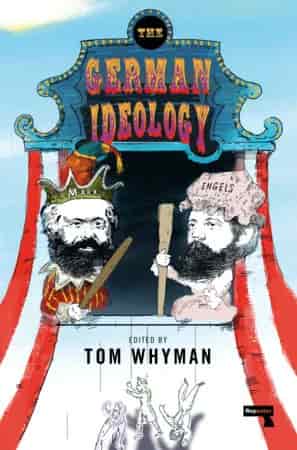
For as soon as the distribution of labour comes into being, each man has a particular exclusive sphere of… — Karl Marx
For as soon as the distribution of labour comes into being, each man has a particular exclusive sphere of activity, which is forced upon him and from which he cannot escape. He is a hunter, a fisherman, a shepherd, or a critical critic and must remain so if he does not wish to lose his means of livelihood; while in communist society, where nobody has one exclusive sphere of activity but each can become accomplished in any branch he wishes, society regulates the general production and thus makes it possible for me to do one thing today and another tomorrow, to hunt in the morning, to fish in the afternoon, rear cattle in the evening, criticize after dinner, just as I have in mind, without ever becoming hunter, fisherman, shepherd or critic.
Source: Wikiquote · CC BY-SA 4.0

More from this book
Thus, while the refugee serfs only wished to be free to develop and assert those conditions of existence which were already there, and hence, in the end, only arrived at free labour, the proletarians, if they are to assert themselves as individuals, will have to abolish the very condition of their existence hitherto (which has, moreover, been that of all society up to the present), namely, labour. Thus they find themselves directly opposed to the form in which, hitherto, the individuals, of which society consists, have given themselves collective expression, that is, the State. In order, therefore, to assert themselves as individuals, they must overthrow the State.
Philosophy stands in the same relation to the study of the actual world as masturbation to sexual love.
p. 103
Where speculation ends — in real life — there real, positive science begins: the representation of the practical activity, of the practical process of development of men. Empty talk about consciousness ceases, and real knowledge has to take place. When reality is depicted, philosophy as an independent branch of activity loses its medium of existence. At the best its place can only be taken by a summing-up of the most general results, abstractions which arise from the observation of the historical development of men. Viewed apart from real history, these abstractions have in themselves no value whatsoever. They can only serve to facilitate the arrangement of historical material, to indicate the sequence of its separate strata. But they by no means afford a recipe or schema, as does philosophy, for neatly trimming the epochs of history. On the contrary, our difficulties begin only when we set about the observation and the arrangement — the real depiction — of our historical material, whether of a past epoch or of the present.