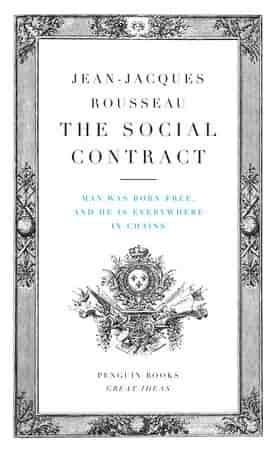
Jean Jacques Rousseau
Quotes
Everything conspires to take away from a man who is set in authority over others the sense of justice and reason.
Sovereignty, for the same reason as makes it inalienable, cannot be represented; it lies essentially in the general will, and will does not admit of representation: it is either the same, or other; there is no intermediate possibility. The deputies of the people, therefore, are not and cannot be its representatives: they are merely its stewards, and can carry through no definitive acts. Every law the people has not ratified in person is null and void - is, in fact, not a law.
Every people, to which its situation gives no choice save that between commerce and war, is weak in itself: it depends on its neighbours, and on circumstances; its existence can never be more than short and uncertain.
Thus in the task of legislation we find together two things which appear to be incompatible: an enterprise too difficult for human powers, and, for its execution, an authority that is no authority. There is a further difficulty that deserves attention. Wise men, if they try to speak their language to the common herd instead of its own, cannot possibly make themselves understood. There are a thousand kinds of ideas which it is impossible to translate into popular language.
In the person of the magistrate we can distinguish three essentially different wills: first, the private will of the individual, tending only to his personal advantage; secondly, the common will of the magistrates, which is relative solely to the advantage of the prince, and may be called corporate will, being general in relation to the government, and particular in relation to the State, of which the government forms part; and, in the third place, the will of the people or the sovereign will, which is general both in relation to the State regarded as the whole, and to the government regarded as a part of the whole.
If, in the different States, the number of supreme magistrates should be in inverse ratio to the number of citizens, it follows that, generally, democratic government suits small States, aristocratic government those of middle size, and monarchy great ones.
What man loses by the social contract is his natural liberty and an unlimited right to everything he tries to get and succeeds in getting; what he gains is civil liberty and the proprietorship of all he possesses.
It is not good for him who makes the laws to execute them, or for the body of the people to turn its attention away from a general standpoint and devote it to particular objects. Nothing is more dangerous than the influence of private interests in public affairs, and the abuse of the laws by the government is a less evil than the corruption of the legislator.
The advantage of tyrannical government therefore lies in acting at great distances. With the help of the rallying-points it establishes, its strength, like that of the lever,26 grows with distance. The strength of the people, on the other hand, acts only when concentrated: when spread abroad, it evaporates and is lost, like powder scattered on the ground, which catches fire only grain by grain. The least populous countries are thus the fittest for tyranny: fierce animals reign only in deserts.
The great soul of the legislator is the only miracle that can prove his mission.
"The problem is to find a form of association which will defend and protect with the whole common force the person and goods of each associate, and in which each, while uniting himself with all, may still obey himself alone, and remain as free as before." This is the fundamental problem of which the Social Contract provides the solution.
Furthermore, none of these three terms can be altered without the equality being instantly destroyed. If the Sovereign desires to govern, or the magistrate to give laws, or if the subjects refuse to obey, disorder takes the place of regularity, force and will no longer act together, and the State is dissolved and falls into despotism or anarchy.