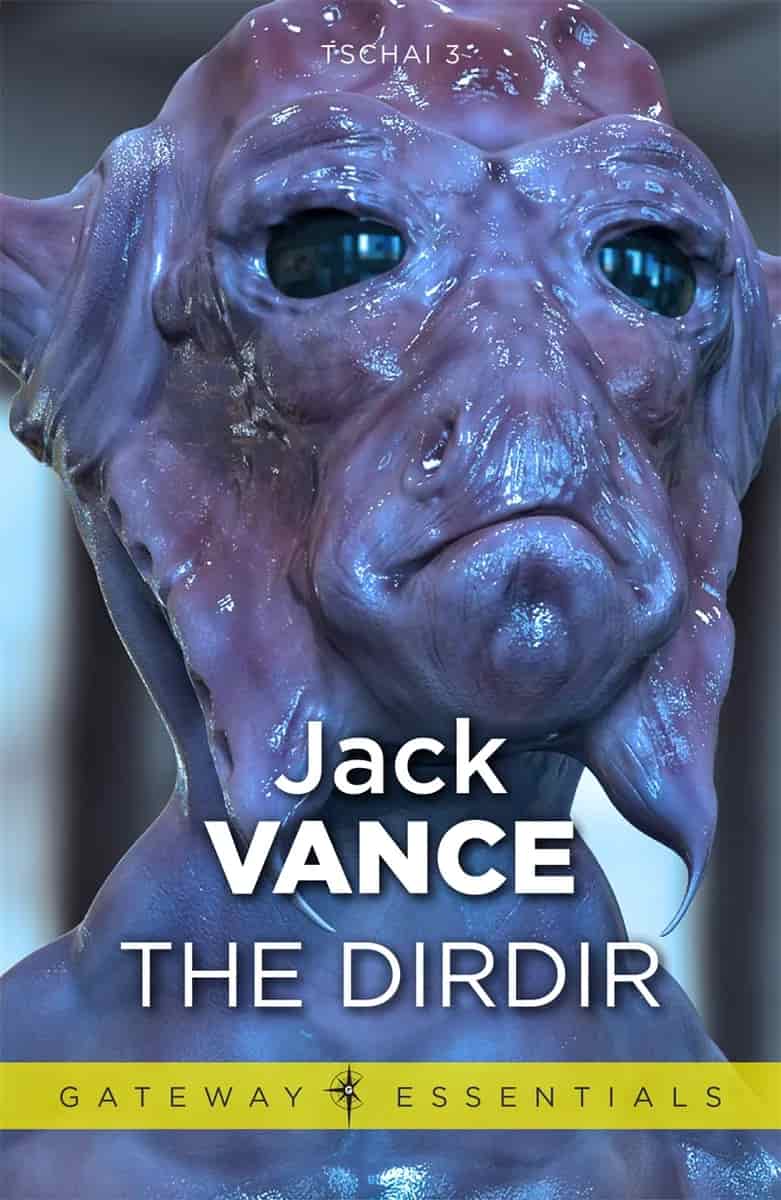
Jack Vance
Quotes
“I have not been tamed,” said Finnerack. “I have only been enslaved.”
p. 83
 The Brave Free Men
It is foolish to be outraged by a fact of nature.
p. 82
The Brave Free MenIgnorance induces suspicion.
p. 233
The Brave Free MenNever neglect the wonder of conscious existence, which too soon comes to an end!
p. 98
The Brave Free MenIfness pursed his lips judiciously. “All folk, mercantilists as well as tavern-keepers and musicians, try to relate their work to abstract universals. We mercantilists are highly sensitive to theft, which stabs at our very essence. To steal is to acquire goods by a simple, informal, and inexpensive process. To buy identical goods is tedious, irksome, and costly. Is it any wonder that larceny is popular? Nonetheless it voids the mercantilist’s reasons for being alive; we regard thieves with the same abhorrence that musicians might feel for a fanatic gang which beat bells and gongs whenever musicians played.”
Frolitz stifled an ejaculation.
Ifness tasted the mug of green cider which Loy had set before him. “To repeat: when a thief steals property he steals life. For a mercantilist I am tolerant of human weakness, and I would not react vigorously to the theft of a day. I would resent the theft of a week; I would kill the thief who stole a year of my life.”
p. 109
 The Anome
Are musicians unlike other men? Beget and forget, that’s how it goes.
p. 16
The AnomeI often reflect upon the word “morality,” the most troublesome and confusing word of all.
There is no single or supreme morality; there are many, each defining the mode by which a system of entities optimally interacts.
The eminent entomologist Fabre, observing a mantis in the act of devouring its mate, exclaimed: “What an abominable custom!”
The ordinary man, during a day’s time, may be obliged to act by the terms of a half dozen different moralities. Some of these acts, appropriate at one moment, may the next moment be considered obscene or opprobrious in terms of another morality.
The person who, let us say, expects generosity from a bank, efficient flexibility from a government agency, open-mindedness from a religious institution will be disappointed. In each purview the notions represent immorality. The poor fool might as quickly discover love among the mantises.
p. 224
 The Book of Dreams
“It goes to demonstrate,” said Reith, “that you can’t judge a man by the table he sets.”
Cauch asked shrewdly, “How then can a man judge his fellows? For example, what is the basis of your calculation?”
“Only one thing I know for certain,” said Reith. “First thoughts are always wrong.”
p. 497
 The Pnume
Where cowards never venture, heroes find splendor.
p. 300
 The Dirdir
“Intelligence” demands the most strict of definitions, since the word is easily and often abused. Intelligence rates the quality of Gaean man’s competence at altering environment to suit his convenience, or, more generally, the solution of problems. The corollaries to the idea are several. Among them: In the absence of problems, intelligence cannot be measured. A creature with a large, complicated brain is not necessarily intelligent. Raw abstract intelligence is a meaningless concept.
p. 383
The Book of DreamsDiscipline in itself is not a corrupt concept, only discipline that is imposed rather than self-calculated.
p. 347
The Book of DreamsThey consider garrulity a crime against nature.
p. 315
The Dirdir