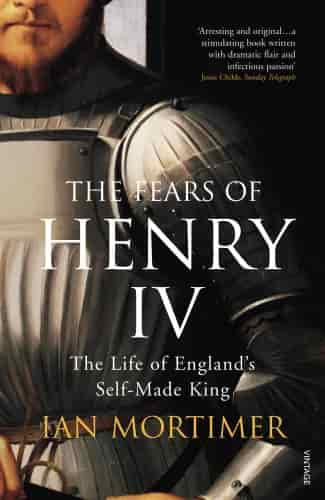
Ian Mortimer
Quotes
Modern scholars now see Richard as essentially narcissistic, convinced of his own perfection, and yet deeply insecure. We might elaborate on this slightly and see that he was exceptionally self-conscious: so much so that his own identity, royal percentage, ideas, rivalries and feelings formed not only the core but the limit of his entire world.
p. 136
 The Fears of Henry IV
The question of whether or not Henry was a great king in the fifteenth century, or subsequently, is a distraction. A man’s character may be obscured as much by the acclamation of greatness as by neglect.
p. 3
The Fears of Henry IVIt is not surprising that Lucia Visconti fell for him [Henry IV]. Considering his crusading, his pilgrimage and his jousting, it is not going too far to say that he had made himself into an exemplary knight, combining the spiritual and chivalric values of his age more completely perhaps than any other Englishman of the late fourteenth century.
p. 115
The Fears of Henry IVA man who grows up believing he is the heir to the throne is unlikely ever to be able to let go of such an idea.
p. 182
The Fears of Henry IVThe original reasons to doubt Richard’s fitness to rule – his unwise grants of lordships and lucrative offices, his lack of military leadership in the face of encroaching enemies and his lack of judgement in political and diplomatic affairs – all remained valid. He continued to advance his favourites and friends without regard for lordly or public opinion.
p. 55
The Fears of Henry IVAnd therein lies the explanation of 1399, one of the most momentous years in English history. Richard personally hated Henry.…Reflecting on their lives from their first meeting, it is obvious that their characters were totally conflicting: Henry was so dutiful, almost ploddingly obedient to his father, Richard so mercurial. Henry was so logical and self-disciplined, Richard so flighty. Henry was so physically confident, Richard so insecure, needing to cocoon himself within his royal self-righteousness. But beyond these reflections, we have to suspect that the very root of Richard’s active hatred (as opposed to passive dislike) was his own fear. He was afraid of Henry as the hero of the joust. He was afraid of his confidence, his affable nature, his logical mind and his strength. And he was afraid of his royalty, and the prophecies concerning the two of them.
p. 164
The Fears of Henry IVA kiss is a fleeting thing, but once it has taken place it cannot be undone.
p. 353
The Fears of Henry IVFew men confront the basic tenets of the society in which they live and try to change them. Very few of those are successful. And even fewer survive to reflect on their success. Henry IV was one of these very few.
p. 363
The Fears of Henry IVMost historians rely on timing and motive in deciding whether Henry was guilty of murder or not. This is unfortunate, for motive is not the same as evidence, and to pretend it is is to risk introducing modern prejudices into a historical argument.
p. 211
The Fears of Henry IVThis brings us to an important point about Henry. He was probably the nearest to an intellectual among all the medieval kings of England.
p. 45
The Fears of Henry IVWhile we may have some sympathy for Richard, his psychological problems had a disastrous effect on the political situation in England.
p. 137
The Fears of Henry IVWhether he paid any attention to the blue-green waters of the lake as he struggled toward the snow-capped mountains in the distance is open to doubt. For men of his day, the beauties of nature were not a great attraction. Surrounded by unspoilt countryside and greenery all the time, it was great buildings which especially excited the fourteenth-century traveller. For Henry and his men, they had the towns and churches of Italy ahead of them, which they were looking forward to seeing far more than the steep slopes of the Alps in the bitter cold.
p. 108
The Fears of Henry IV