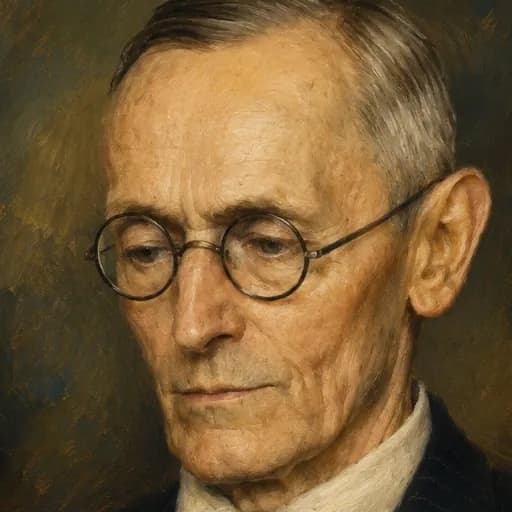
Hermann Hesse
Quotes
You, too, have mysteries of your own. I know that you must have dreams that you don't tell me. I don't want to know them. But I can tell you: live those dreams, play with them, build altars to them. It is not yet the ideal but it points in the right direction. Whether you and I and a few others will renew the world someday remains to be seen. But within ourselves we must renew it each day, otherwise we just aren't serious. Don't forget that!
p. 181
It is not our purpose to become each other; it is to recognize each other, to learn to see the other and honor him for what he is: each the other's opposite and complement. Ch. IV
One thing, however, did become clear to him [Goldmund] – why so many perfect works of art did not please him at all, why they were almost hateful and boring to him, in spite of a certain undeniable beauty. Workshops, churches, and palaces were full of these fatal works of art; he had even helped with a few himself. They were deeply disappointing because they aroused the desire for the highest and did not fulfill it. They lacked the most essential thing – mystery. That was what dreams and truly great works of art had in common: mystery.
Isolated here in the North, planted long ago by a Roman pilgrim, a chestnut grew, strong and solitary, by the colonnade of rounded double arches at the entrance to the cloister of Mariabronn: a noble, vigorous tree, the sweep of its foliage drooping tenderly, facing the winds in bold and quiet assurance; so tardy in spring that when all glowed green around it and even the cloister nut trees wore their russet, it awaited the shortest nights to thrust forth, through little tufts of leaves, the dim exotic rays of its blossom, and in October, after wine and harvests had long been gathered, let drop the prickly fruits from its yellowing crown... The lovely tree, aloof and tender, shadowed the entrance to the cloister, a delicate, shuddering guest from a warmer clime, secretly akin to the slender double columns of the gateway, the pillars and mouldings of the window arches, loved by all Latins and Italians, gaped at, as a stranger, by the inhabitants. Ch. I
One of the aphorisms occurred to me now and I wrote it under the picture: "Fate and temperament are two words for one and the same concept." That was clear to me now.
p. 162
Abraxas was the god who was both god and devil.
p. 168
I do not consider myself less ignorant than most people. I have been and still am a seeker, but I have ceased to question stars and books; I have begun to listen to the teachings my blood whispers to me. My story is not a pleasant one; it is neither sweet nor harmonious, as invented stories are; it has the taste of nonsense and chaos, of madness and dreams — like the lives of all men who stop deceiving themselves.
Each man's life represents the road toward himself, and attempt at such a road, the intimation of a path. No man has ever been entirely and completely himself. Yet each one strives to become that — one in an awkward, the other in a more intelligent way, each as best he can.
p. 9
Novelists when they write novels tend to take an almost godlike attitude toward their subject, pretending to a total comprehension of the story, a man's life, which they can therefore recount as God Himself might, nothing standing between them and the naked truth, the entire story meaningful in every detail. I am as little able to do this as the novelist is, even though my story is more important to me than any novelist's is to him — for this is my story; it is the story of a man, not of an invented, or possible, or idealized, or otherwise absent figure, but of a unique being of flesh and blood. Yet, what a real living human being is made of seems to be less understood today than at any time before, and men — each one of whom represents a unique and valuable experiment on the part of nature — are therefore shot wholesale nowadays. If we were not something more than unique human beings, if each one of us could really be done away with once and for all by a single bullet, story telling would lose all purpose. But every man is more than just himself; he also represents the unique, the very special and always significant and remarkable point at which the world's phenomena intersect, only once in this way and never again. That is why every man's story is important, eternal, sacred; that is why every man, as long as he lives and fulfills the will of nature, is wondrous, and worthy of every consideration. In each individual the spirit has become flesh, in each man the creation suffers, within each one a redeemer is nailed to the cross.
Few people nowadays know what man is. Many sense this ignorance and die the more easily because of it, the same way that I will die more easily once I have completed this story.
p. 9
Then came those years in which I was forced to recognize the existence of a drive within me that had to make itself small and hide from the world of light. The slowly awakening sense of my own sexuality overcame me, as it does every person, like an enemy and terrorist, as something forbidden, tempting, and sinful. What my curiosity sought, what dreams, lust and fear created — the great secret of puberty — did not fit at all into my sheltered childhood. I behaved like everyone else. I led the double life of a child who is no longer a child. My conscious self lived within the familiar and sanctioned world; it denied the new world that dawned within me. Side by side with this I lived in a world of dreams, drives and desires of a chthonic nature, across which my conscious self desperately built its fragile bridges, for the childhood world within me was falling apart. Like most parents, mine were no help with the new problems of puberty, to which no reference was ever made. All they did was take endless trouble in supporting my hopeless attempts to deny reality and to continue dwelling in a childhood world that was becoming more and more unreal. I have no idea whether parents can be of help, and I do not blame mine. It was my own affair to come to terms with myself and to find my own way, and like most well-brought-up children, I managed it badly.
p. 135
I live in my dreams — that's what you sense. Other people live in dreams, but not in their own. That's the difference.
p. 183
The bird fights its way out of the egg. The egg is the world. Who would be born must first destroy a world. The bird flies to God. The God's name is Abraxas.
p. 166
People with courage and character always seem sinister to the rest. It was a scandal that a breed of fearless and sinister people ran around freely, so they attached a nickname and a myth to these people to get even with them, to make up for the many times they had felt afraid.
p. 123