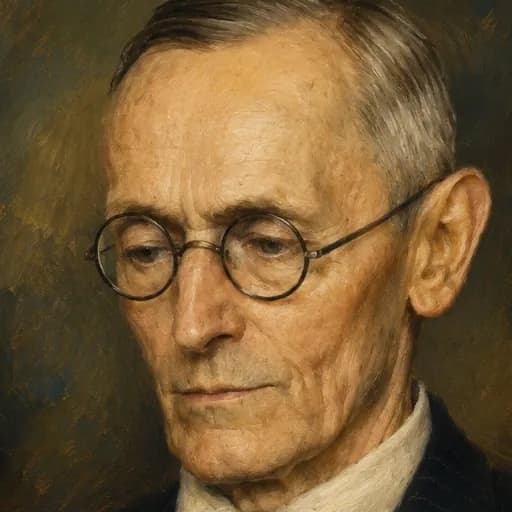
Hermann Hesse
Quotes
Each man had only one genuine vocation — to find the way to himself
p. 193
My wish for you two young scholars is that you may never lack a superior whose wits are duller than your own. No salve for pride is better than that. Ch. I
For a while the cloister of Mariabronn was renowned for its exorcists and devil-chasers; for a while for the beauty of its plain chaunt; then for a saintly father who healed and wrought miracles; then for its pike broth and stag’s liver pasty - each in its time.
Many generations of cloister schoolboys had trooped past beneath this stranger tree, laughing, gossiping, playing, squabbling, shod or barefoot, according to the season of the year; each with his writing-tablet; boys with a flower between their lips, boys cracking nuts, boys with snowballs. Always there were new ones; every second year brought its fresh faces, though most - tousled and yellow-haired - were very like the boys that had passed. Some stayed and turned into novices, then monks, and their yellow hair was shorn. Ch. I
Of the many monks who had thronged the church, the dormitories and study-rooms, there were two, remarked by all, whom all were watching - Abbot Daniel and the teaching novice, Narziss, only recently entered in the novitiate, yet already, against all tradition, and because of his exceptional gifts, employed, in Greek especially, as a teacher. These two, the novice and the abbot, were respected and heeded by all the house. They were watched and aroused curiosity, admired and envied, slandered in secret. Ch. I
In the cells and schoolrooms of the cloister, between the strong double redstone pillars and rounded arches, monks lived, taught, administered, studied, ruled. Every branch of science was pursued there, and inherited by each new generation: divine and worldly lore, the dark and the light.
All existence seemed to be based on duality, on contrast. Either one was a man or one was a woman, either a wanderer or sedentary burgher, either a thinking person or a feeling person-no one could breathe in at the same time as he breathed out, be a man as well as a woman, experience freedom as well as order, combine instinct and mind. One always had to pay for one with the loss of the other, and one thing was always just as important and desirable as the other.
The world, as it is now, wants to die, wants to perish — and it will.
p. 199
‘I am not that wanton whose feet you stroked beneath the table. You seem only to know such women as that.’
‘No, God be praised, you are far more beautiful, and finer.’
‘That was not what I meant’
‘No, but it is so. Do you know how beautiful you are?’
‘I have my looking-glass.’
‘Did you ever look and see your forehead in it, Lydia? And your shoulders and your little finger-nails; and then your knees? And have you seen how all these things belong to each other, how all has the same long, beautiful shape? Have you seen it?’ Ch IX
Goldmund smiled up into his eyes, with the new smile he had brought home from his travels, the smile which seemed so frail and old, uncertain, at times, and feeble-witted, and then again pure goodness and pure wisdom.
There was room for repentance and solitude; room for good living and company.
They had sat discussing astrology, a forbidden science, and not pursued in the cloister. Narziss had said that it was a striving to order and arrange after their kinds the many diverse sorts of human beings, their predestined character and their fates,
Here Goldmund broke into his words. ‘You speak of nothing but differences! I have slowly begun to see that they form your own particular whimsey. When you speak of this great difference between us I always feel that it lies in nothing, save in your own strange hankering to find differences.’
Narziss: ‘Right. You have hit the nail on the head. That is what I mean - that to you differences mean little, while to me they are the most important things. Mine is the nature of a scholar, and my branch of scholarship is science. And science, to quote your own words, is nothing else than a “strange hankering after differences”. Her essence could not be better defined. For men of science nothing is so important, as the clear definition of differences. To find, for instance, on every man, those signs which mark him off from all other men: that is to know him.’
Goldmund : ‘But how? One has peasant’s shoes and is a peasant; another a crown on his head, and is a king. There are your differences! But these are seen by children, without, any science.’
Narziss; ‘Yet when peasant and king are clad alike children can no longer distinguish between them.’ Ch. IV