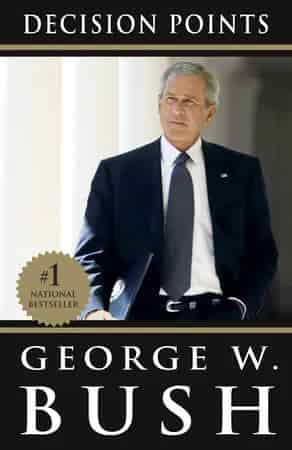
Decision Points is based primarily on my recollections. With help from researchers, I have confirmed my… — George W. Bush
Decision Points is based primarily on my recollections. With help from researchers, I have confirmed my account with government documents, contemporaneous notes, personal interviews, news reports, and other sources, some of which remain classified. There were instances in which I had to rely on memory alone. If there are inaccuracies in this book, the responsibility is mine. In the pages that follow, I have done my best to write about the decisions I got right, those I got wrong, and what I would do differently if given the chance. Of course, in the presidency, there are no do-overs. You have to do what you believe is right and accept the consequences. I tried to do that every day of my eight years in office. Serving as president was the honor of a lifetime, and I appreciate your giving me the opportunity to share my story.
Source: Wikiquote · CC BY-SA 4.0
More from this book
The stem cell debate was an introduction to a phenomenon I witnessed throughout my presidency: highly personal criticism. Partisan opponents and commentators questioned my legitimacy, my intelligence, and my sincerity. They mocked my appearance, my accent, and my religious beliefs. I was labeled a Nazi, a war criminal, and Satan himself. That last one came from a foreign leader, Venezuelan President Hugo Chavez. One lawmaker called me both a loser and a liar. He became majority leader of the U.S. Senate. In some ways, I wasn't surprised. I had endured plenty of rough politics in Texas. I had seen Dad and Bill Clinton derided by their opponents and the media. Abraham Lincoln was compared to a baboon. Even George Washington became so unpopular that political cartoons showed the hero of the American revolution being marched to the guillotine. Yet the death spiral of decency during my time in office, exacerbated by the advent of twenty-four-hour cable news and hyper-partisan political blogs, was deeply disappointing. The toxic atmosphere in American politics discourages good people from running for office.
p. 121
To the loves of my life: Laura, Barbara, and Jenna
Kanye West told a prime-time T.V. audience, "George Bush doesn't care about black people." Jesse Jackson later compared the New Orleans Convention Center to the "hull of a slave ship". A member of the Congressional Black Caucus claimed that if the storm victims had been "white, middle-class Americans" they would have received more help. Five years later, I can barely write those words without feeling disgusted. I am deeply insulted by the suggestion that we allowed American citizens to suffer because they were black. As I told the press at the time, "The storm didn't discriminate, and neither will we. When those coast guard choppers, many of whom were first on the scene, were pulling people off roofs, they didn't check the color of a person's skin." The more I thought about it, the angrier I felt. I was raised to believe that racism was one of the greatest evils in society. I admired dad's courage when he defied near-universal opposition from his constituents to vote for the Open Housing Bill of 1968. I was proud to have earned more black votes than any Republican governor in Texas history. I had appointed African Americans to top government positions, including the first black woman national security adviser and the first two black secretaries of state. It broke my heart to see minority children shuffled through the school system, so I had based my signature domestic policy initiative, the No Child Left Behind Act, on ending the soft bigotry of low expectations. I had launched a $15 billion program to combat HIV/AIDS in Africa. As part of the response to Katrina, my administration worked with Congress to provided historically black colleges and universities in the Gulf Coast with more than $400 million in loans to restore their campuses and renew their recruiting efforts.
p. 325