Eric R. Kandel
Quotes
Science may explain aspects of art but it will not replace the inspiration that art evokes...
In Vienna, Modernism had three main characteristics. The first was the new view of the human mind as being largely irrational by nature. ...they questioned what constitutes reality, what lies below the surface appearances of people, objects, and events. ...They discovered that ...people harbor not only unconscious erotic feelings, but also unconscious aggressive impulses that are directed against themselves as well as against others. Freud later called these dark impulses the death instinct.
Modernism began in the mid-nineteenth century as a response not only to the restrictions and hypocrisies of everyday life, but also as a reaction to the Enlightenment's emphasis on the rationality of human behavior. ...The founders of the Royal Society thought of God as a mathematician who had designed the universe according to logical and mathematical principles. The role of the scientist—the natural philosopher was to... decipher the codebook that God had used in creating the cosmos.
The Modernist reaction to the Enlightenment came in the aftermath of the Industrial Revolution, whose brutalizing effects revealed that modern life had not become... mathematically perfect...
The remarkable insight that characterized Klimt's later work was contemporaneous with Freud's psychological studies and presaged the inward turn that would pervade all fields of inquiry in Vienna in 1900. This period... was characterized by the attempt to make a sharp break with the past and to explore new forms of expression in art, architecture, psychology, literature, and music. It spawned an ongoing pursuit to link these disciplines.
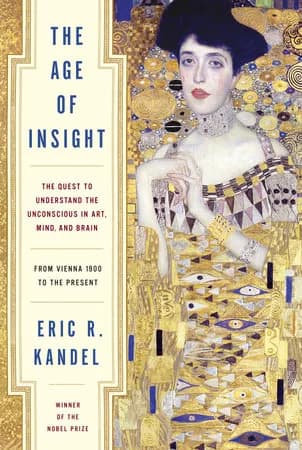
As the art historian Emily Braun has documented, Klimt read Darwin and became fascinated with the structure of the cell... Thus, the small iconographic images on Adelle's dress are not simply decorative... they are symbols of male and female cells: rectangular sperm and ovoid eggs. ...designed to match the sitter's seductive face and her full-blown reproductive capacities.
Viennese life at the turn of the century provided opportunities in salons and coffeehouses for scientists, writers, and artists to come together in an atmosphere that was at once inspiring, optimistic, and politically engaged. ...science was no longer the narrow and restrictive province of scientists but had become an integral part of Viennese culture. ...a paradigm for how an open dialogue can be achieved.
The Copernican revolution... revealed that the earth is not the center of the universe... The second, the Darwinian revolution... revealed that we are not created divinely or uniquely but instead evolved from simpler animals by a process of natural selection. The third great revolution, the Freudian revolution of Vienna 1900, revealed that we do not consciously control our own actions but are instead driven by unconscious motives. This... later led to the idea that human creativity... stems from conscious access to underlying, unconscious forces.
As astronomy and physics inspired the Enlightenment, so biology inspired Modernism. ...This new view led to a reexamination in art of the biological nature of human existence, as evident in Édouard Manet's Déjeuner sur l’Herbe... Manet's painting... reveals a theme... the complex relationship between the sexes and between fantasy and reality. ...also startlingly modern because of its style. Several decades before Cézanne began to collapse three dimension into two, Manet here had already flattened the viewer's sense of perspective...
Reductionism can expand our vision and give us new insights into the nature and creation of art.
The realization that our mental functioning is largely irrational was arrived at by several thinkers at the same time, including Friedrich Nietzsche... Freud, who was much influenced by both Darwin and Nietzsche... was its most profound and articulate exponent. ...Schnitzler, Klimt, Kokoschka, and Schiele also discovered and explored new aspects of our unconscious mental life. They understood women better than Freud... and they saw more clearly than Freud the importance of an infant's bonding to its mother. They even realized the significance of the aggressive instinct earlier than Freud did. ...Plato discussed unconscious knowledge ...pointing out that much of our knowledge is inherent in the psyche in latent form. ...Hermann von Helmholtz... advanced the idea that the unconscious plays a critical role in human visual perception.
Like other modern artists faced with the advent of the photography, Klimt sought newer truths that could not be captured by the camera. He... turned the artists view inward—away from the three-dimensional outside world and toward the multidimensional inner self and the unconscious mind.