
Emma Goldman
Quotes
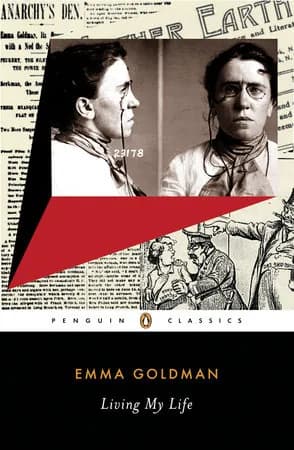
My own long struggle to find my bearings, the disillusionments and disappointments I had experienced, had made me less dogmatic in my demands on people than I had been. They had helped me to understand the hard and lonely life of the rebel who had fought for an unpopular cause. Whatever bitterness I had felt against my old teacher had given way to deep sympathy long before his death. (about Johann Most)
My life — I had lived in its heights and its depths, in bitter sorrow and ecstatic joy, in black despair and fervent hope. I had drunk the cup to the last drop. I had lived my life. Would I had the gift to paint the life I had lived! (chapter 56)
As to killing rulers, it depends entirely on the position of the ruler. If it is the Russian tsar, I most certainly believe in dispatching him to where he belongs. If the ruler is as ineffectual as an American president, it is hardly worth the effort. There are, however, some potentates I would kill by any and all means at my disposal. They are Ignorance, Superstition, and Bigotry — the most sinister and tyrannical rulers on earth. (p. 207) -->
The people are asleep; they remain indifferent. They forge their own chains and do the bidding of their masters to crucify their Christs. (p. 304)
I do not believe in God, because I believe in man. Whatever his mistakes, man has for thousands of years past been working to undo the botched job your God has made. (p. 207)
Nothing would prove more disastrous to our ideas, we contended, than to neglect the effect of the internal upon the external, of the psychological motives and needs upon existing institutions. (p. 402)
I spoke after Sasha, for an hour. I discussed the farce of a government undertaking to carry democracy abroad by suppressing the last vestiges of it at home. I took up the contention of Judge Mayer that only such ideas are permissible as are "within the law." Thus he had instructed the jurymen when he had asked them if they were prejudiced against those who propagate unpopular ideas. I pointed out that there had never been an ideal, however humane and peaceful, which in its time had been considered "within the law." I named Jesus, Socrates, Galileo, Giordano Bruno. "Were they 'within the law"?" I asked. "And the men who set America free from British rule, the Jeffersons and the Patrick Henrys? The William Lloyd Garrisons, the John Browns, the David Thoreaus and Wendell Phillipses-were they within the law?" (chapter 45)
At the dances I was one of the most untiring and gayest. One evening a cousin of Sasha, a young boy, took me aside. With a grave face, as if he were about to announce the death of a dear comrade, he whispered to me that it did not behoove an agitator to dance. Certainly not with such reckless abandon, anyway. It was undignified for one who was on the way to become a force in the anarchist movement. My frivolity would only hurt the Cause.
I grew furious at the impudent interference of the boy. I told him to mind his own business. I was tired of having the Cause constantly thrown into my face. I did not believe that a Cause which stood for a beautiful ideal, for anarchism, for release and freedom from convention and prejudice, should demand the denial of life and joy. I insisted that our Cause could not expect me to become a nun and that the movement would not be turned into a cloister. If it meant that, I did not want it. "I want freedom, the right to self-expression, everybody's right to beautiful, radiant things." Anarchism meant that to me, and I would live it in spite of the whole world — prisons, persecution, everything. Yes, even in spite of the condemnation of my own closest comrades I would live my beautiful ideal. (p. 56)
No sacrifice is lost for a great ideal! (p. 135)
The free expression of the hopes and aspirations of a people is the greatest and only safety in a sane society.
America had declared war with Spain.... It did not require much political wisdom to see that America's concern was a matter of sugar and had nothing to do with humanitarian feelings. Of course there were plenty of credulous people, not only in the country at large, but even in liberal ranks, who believed in America's claim. I could not join them. I was sure that no one, be it individual or government, engaged in enslaving and exploiting at home, could have the integrity or the desire to free people in other lands. (p. 226)
That’s all the quotes.
11 quotes in the collection · come back when we add more