
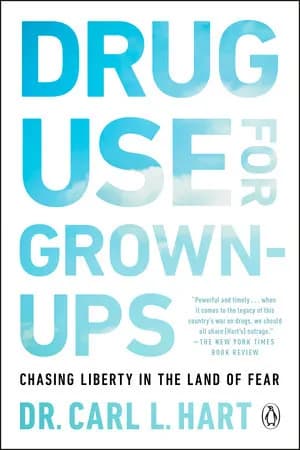
Quotes
I'm now firm in my belief that marijuana is a key ingredient to happiness for a great number of people. What kind of person prevents another's responsible pursuit of happiness? Not a very humane one.
Drugs are inert substances. The evidence tells us that we must look beyond the drug itself when trying to help people with drug addiction.
A broader argument I make within these pages is that adults should be permitted the legal right to sell, purchase, and use recreational drugs of their choice, just as they have the rights to engage in consensual sexual behaviors, drive automobiles, and even purchase and use guns. Of course, all these activities carry some level of risk, including death. But rather than banning sex, cars, or guns, we have implemented age and competence requirements as well as other safety strategies, strategies that minimize harms and enhance positive features associated with these activities. This is already done, of course, with the widely used recreational drug known as alcohol. After reading this book, you will, I hope, come to the inescapable conclusion that the same should be done with other recreational drugs.
my conscience will no longer allow me to remain silent about my drug use, nor can I remain silent about the absurdity of punishing people for what they put into their own bodies...The point is that whether I use a drug or not is my decision; it is not the government's decision.
I am an unapologetic drug user. I take drugs as part of my pursuit of happiness, and they work. I am a happier and better person because of them. I am also a scientist and a professor of psychology specializing in neuroscience at Columbia University, known for my work on drug abuse and addiction. It has taken me more than two decades to come out of the closet about my personal drug use. Simply put, I have been a coward.
Each and every day, we all are faced with potential risks and must make risk-to-benefit calculations repeatedly. This is a basic fact of life. Our right to make decisions based on the outcome of these calculations is not outlawed by the government, except when it comes to certain recreational drugs. (Chapter 2)
Addiction represents a minority of drug effects, but it receives almost all the attention, certainly the media attention. Think about that. Have you ever read a newspaper article or seen a film about heroin that didn't focus on addiction? Imagine if you were interested in learning more about cars or driving and could only find information about car crashes or information about how to repair a car after a crash. That would be ridiculous.
Would we tolerate children being removed from their mother just because she drank a glass of wine?...Can you imagine being told that your child is better off without you merely because you smoked a joint?...The fact is that many parents who use drugs are good parents, and their children are clearly better off with them.
More and more, I came to realize that drug-abuse scientists, especially government-funded ones, focus almost exclusively on the detrimental effects of drugs, even though these are, in fact, a minority of effects. This has had a damning impact on how so-called recreational drugs are regulated and inevitably on your own decision as to whether or not to partake of them.
From my own experience-the combination of my scientific work and my personal drug use, I have learned that recreational drugs can be used safely to enhance many vital human activities.
the first priority of law enforcement should be to keep users safe, not to arrest them.
America's drug regime is a monstrous, incoherent mess.
If our current government-or any government-were genuinely concerned about the health and safety of drug users, it would ensure that free, anonymous drug-safety testing services were widely available. This practical approach informs users of the contents of their substances and decreases the likelihood of people ingesting fatal amounts of unknown substances.
The main effects of smoking marijuana are contentment, relaxation, sedation, euphoria, and increased hunger, all peaking within five to fifteen minutes after smoking and lasting for about two hours...very high THC concentrations...can cause mild paranoia and visual and auditory distortions, but even these effects are rare and usually seen only in very inexperienced users.
the reefer-madness rhetoric of the past has not evaporated; it has evolved and reinvented itself...with each new generation, the myth of reefer madness is revamped and disguised as empirical evidence rather than as what it is: misinformed rhetoric.
I share my story in an effort to encourage others, especially successful professionals who are less at risk than people on the margins of society, to get out of the closet about their own drug use. If they did so, more people would see that there are far more respectable drug users than our criminal-justice regime and popular culture would have us know.
If the ideas expressed in this book are embraced, we can get on with the business of treating each other better and enjoying more meaningful and fulfilling lives. And isn't that what we all want?
Here's the bottom line: over my more than twenty-five-year career, I have discovered that most drug-use scenarios cause little or no harm and that some responsible drug-use scenarios are actually beneficial for human health and functioning. Even "recreational" drugs can and do improve day-to-day living.
Contrary to popular media portrayals, most drug users are not addicts. They are responsible members of their communities. They pay their bills and taxes on time; they take care of their families; and they volunteer in their local and global communities. They are artists, engineers, firemen, homemakers, judges, lawyers, pastors, physicians, politicians, professors, schoolteachers, scientists, social workers, truck drivers, writers, and many other types of professionals.
all drugs can produce both negative and positive effects. So to act as if marijuana is intrinsically or morally superior to heroin-or any other drug, for that matter-highlights the ignorance of the holder of this belief. Such ignorance also decreases the odds of people honestly reporting the use of drugs other than marijuana because of the stigma attached to so-called harder drugs, such as heroin. (Chapter 2)
The key is to keep the focus on people's actions, on their behaviors, rather than speculate about their motives. Trying to determine what's in a person's head or heart is a pointless distraction. It's impossible to know for certain the heart's inner secrets.
Attention-grabbing headlines claiming that opioids (or any other drug) are killing people are wrong. Ignorance and poverty are killing people, just as they have for centuries.
the war on drugs is not a war on drugs; it’s a war on us.
Heroin and other opioids, such as oxycodone and morphine, bring me pleasurable calmness, just as alcohol may function for the drinker subjected to uncomfortable social settings. Opioids are outstanding pleasure producers; I am now entering my fifth year as a regular heroin user. I do not have a drug-use problem. Never have. Each day, I meet my parental, personal, and professional responsibilities. I pay my taxes, serve as a volunteer in my community on a regular basis, and contribute to the global community as an informed and engaged citizen. I am better for my drug use.
Clearly, many people consume psychoactive substances “in the pursuit of happiness,” a right the government was established to secure, to protect. So why then is our current government arresting one million Americans each year for possessing drugs? Why are so many drug users hiding in the closet? This reality does not align with the spirit of the Declaration
I wrote this book to present a more realistic image of the typical drug user: a responsible professional who happens to use drugs in his pursuit of happiness. Also, I wanted to remind the public that no benevolent government should forbid autonomous adults from altering their consciousness, as long as it does not infringe on the rights of others. (Author's Note)
As with previous “drug crises,” the opioid problem is not really about opioids. It’s mainly about cultural, social, and environmental factors such as racism, draconian drug laws, and diverting attention away from the real causes of crime and suffering.
After reading this book, I hope you will be less likely to vilify individuals merely because they use drugs. That thinking has led to an incalculable number of deaths and an enormous amount of suffering. I hope you will come away with an appreciation for the prodigious potential good derived from drug use and a deeper understanding of why so many responsible grown-ups engage in this behavior. (Author's Note)
That’s all the quotes.
28 quotes in the collection · come back when we add more