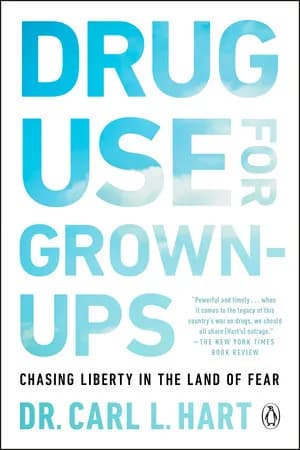
Carl L. Hart
Quotes
I'm now firm in my belief that marijuana is a key ingredient to happiness for a great number of people. What kind of person prevents another's responsible pursuit of happiness? Not a very humane one.
Drugs are inert substances. The evidence tells us that we must look beyond the drug itself when trying to help people with drug addiction.
A broader argument I make within these pages is that adults should be permitted the legal right to sell, purchase, and use recreational drugs of their choice, just as they have the rights to engage in consensual sexual behaviors, drive automobiles, and even purchase and use guns. Of course, all these activities carry some level of risk, including death. But rather than banning sex, cars, or guns, we have implemented age and competence requirements as well as other safety strategies, strategies that minimize harms and enhance positive features associated with these activities. This is already done, of course, with the widely used recreational drug known as alcohol. After reading this book, you will, I hope, come to the inescapable conclusion that the same should be done with other recreational drugs.
my conscience will no longer allow me to remain silent about my drug use, nor can I remain silent about the absurdity of punishing people for what they put into their own bodies...The point is that whether I use a drug or not is my decision; it is not the government's decision.
I am an unapologetic drug user. I take drugs as part of my pursuit of happiness, and they work. I am a happier and better person because of them. I am also a scientist and a professor of psychology specializing in neuroscience at Columbia University, known for my work on drug abuse and addiction. It has taken me more than two decades to come out of the closet about my personal drug use. Simply put, I have been a coward.
Each and every day, we all are faced with potential risks and must make risk-to-benefit calculations repeatedly. This is a basic fact of life. Our right to make decisions based on the outcome of these calculations is not outlawed by the government, except when it comes to certain recreational drugs. (Chapter 2)
Addiction represents a minority of drug effects, but it receives almost all the attention, certainly the media attention. Think about that. Have you ever read a newspaper article or seen a film about heroin that didn't focus on addiction? Imagine if you were interested in learning more about cars or driving and could only find information about car crashes or information about how to repair a car after a crash. That would be ridiculous.
Would we tolerate children being removed from their mother just because she drank a glass of wine?...Can you imagine being told that your child is better off without you merely because you smoked a joint?...The fact is that many parents who use drugs are good parents, and their children are clearly better off with them.
More and more, I came to realize that drug-abuse scientists, especially government-funded ones, focus almost exclusively on the detrimental effects of drugs, even though these are, in fact, a minority of effects. This has had a damning impact on how so-called recreational drugs are regulated and inevitably on your own decision as to whether or not to partake of them.
From my own experience-the combination of my scientific work and my personal drug use, I have learned that recreational drugs can be used safely to enhance many vital human activities.
the first priority of law enforcement should be to keep users safe, not to arrest them.
America's drug regime is a monstrous, incoherent mess.