
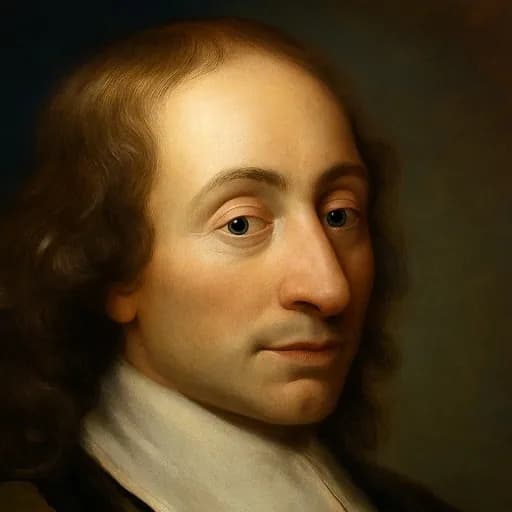
Blaise Pascal
Quotes
...it is to judgment that perception belongs, as science belongs to intellect. Intuition is the part of judgment, mathematics of intellect.
...when we wish to demonstrate a general theorem, we must give the rule as applied to a particular case; but if we wish to demonstrate a particular case, we must begin with the general rule. For we always find the thing obscure which we wish to prove, and that clear which we use for the proof; for, when a thing is put forward to be proved, we first fill ourselves with the imagination that it is therefore obscure, and on the contrary that what is to prove it, is clear, and so we understand it easily.
...as nature has graven her image and that of her Author on all things, they almost all partake of her double infinity. Thus we see that all the sciences are infinite in the extent of their researches. For who doubts that geometry, for instance, has an infinite infinity of problems to solve? They are also infinite in the multitude and fineness of their premises; for it is clear that those which are put forward as ultimate are not self-supporting, but are based on others which, again having others for their support, do not permit of finality. ...Of these two Infinites of science, that of greatness is the most palpable, and hence a few persons have pretended to know all things. ...the infinitely little is the least obvious. Philosophers have much oftener claimed to have reached it, and it is here they have all stumbled. ...we need no less capacity for attaining the Nothing than the All. Infinite capacity is required for both, and it seems to me that whoever shall have understood the ultimate principles of being might also attain to the knowledge of the Infinite. The one depends on the other, and one leads to the other. These extremes meet and reunite by force of distance, and find each other in God, and in God alone.
Epictetus goes much further when he asks: Why do we not lose our temper if someone tells us that we have a headache, while we do lose it if someone says there is anything wrong with our arguments or our choice?
Those who are accustomed to judge by feeling do not understand the process of reasoning, for they would understand at first sight, and are not used to seek for principles. And others, on the contrary, who are accustomed to reason from principles, do not at all understand matters of feeling, seeking principles, and being unable to see at a glance.
When we wish to correct with advantage, and to show another that he errs, we must notice from what side he views the matter, for on that side it is usually true, and admit that truth to him, but reveal to him the side on which it is false. He is satisfied with that, for he sees that he was not mistaken, and that he only failed to see all sides.
One must know oneself. If this does not serve to discover truth, it at least serves as a rule of life, and there is nothing better.
...it is rare that mathematicians are intuitive, and that men of intuition are mathematicians, because mathematicians wish to treat matters of intuition mathematically, and make themselves ridiculous, wishing to begin with definitions and then with axioms, which is not the way to proceed in this kind of reasoning. Not that the mind does not do so, but it does it tacitly, naturally, and without technical rules; for the expression of it is beyond all men, and only a few can feel it.
Man is to himself the most wonderful object in nature; for he cannot conceive what the body is, still less what the mind is, and least of all how a body should be united to a mind. This is the consummation of his difficulties, and yet it is his very being.
I always feel uncomfortable under such complements as these: "I have given you a great deal of trouble," "I am afraid I am boring you," "I fear this is too long." We either carry our audience with us, or irritate them.
Poetical beauty. ...We know well what is the object of mathematics, and that it consists of proofs, and what is the object of medicine, and that it consists of healing. But we do not know in what grace consists, which is the object of poetry.
Lust is the source of all our actions, and humanity, &c.

