
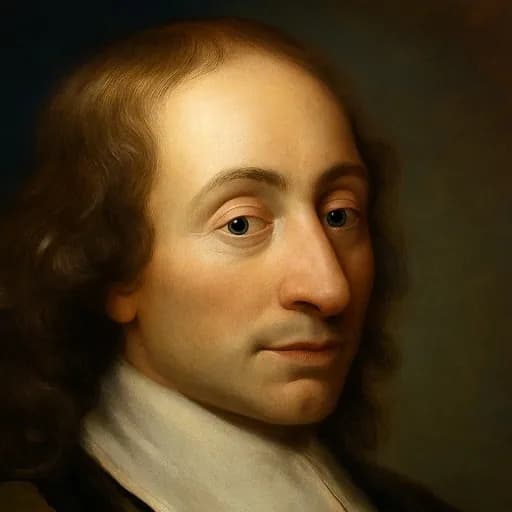
Blaise Pascal
Quotes
When a natural discourse paints a passion or an effect, one feels within oneself the truth of what one reads, which was there before, although one did not know it. Hence one is inclined to love him who makes us feel it, for he has not shown us his own riches, but ours. ...such community of intellect that we have with him necessarily inclines the heart to love.
Dull minds are never either intuitive or mathematical.
Beauty of omission, of judgment.
No one passes in the world as skilled in verse unless he has put up the sign of a poet, a mathematician, &c. But educated people do not want a sign, and draw little distinction between the trade of a poet and that of an embroiderer.
Man loves malice, but not against one-eyed men nor the unfortunate, but against the fortunate and proud.
The same meaning changes with the words which express it. Meanings receive their dignity from words instead of giving it to them.
Certain authors, speaking of their works, say, "My book," "My commentary," "My history," etc. They resemble middle-class people who have a house of their own, and always have "My house" on their tongue. They would do better to say, "Our book," "Our commentary," "Our history," etc., because there is in them usually more of other people's than their own.
One says that the sovereign good consists in virtue, another in pleasure, another in the knowledge of nature, another in truth, another in total ignorance, another in indolence, others in disregarding appearances, another in wondering at nothing, and the true skeptics in their indifference, doubt, and perpetual suspense, and others, wiser, think to find a better definition. We are well satisfied.
It [eloquence] consists, then, in a correspondence which we seek to establish between the head and the heart of those to whom we speak on the one hand, and, on the other, between the thoughts and the expressions which we employ. ...We must put ourselves in the place of those who are to hear us, and make trial on our own heart... We ought to restrict ourselves, so far as possible, to the simple and natural, and not to magnify that which is little, or belittle that which is great. It is not enough that a thing be beautiful; it must be suitable to the subject, and there must be in it nothing of excess or defect.
For after all what is man in nature? A nothing in relation to infinity, all in relation to nothing, a central point between nothing and all and infinitely far from understanding either. The ends of things and their beginnings are impregnably concealed from him in an impenetrable secret. He is equally incapable of seeing the nothingness out of which he was drawn and the infinite in which he is engulfed.
A maker of witticisms, a bad character.
...no one is offended at not seeing everything; but one does not like to be mistaken, and that perhaps arises from the fact that man naturally cannot see everything, and that naturally he cannot err in the side he looks at, since the perceptions of our senses are always true.

