
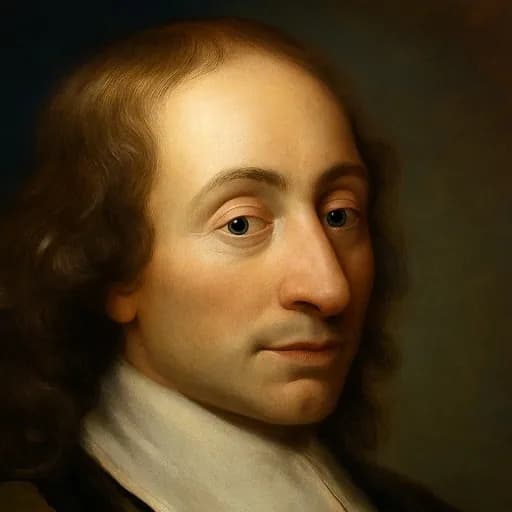
Blaise Pascal
Quotes
I might well have taken this discourse in an order like this: to show the vanity of all conditions of men, to show the vanity of ordinary lives, and then the vanity of philosophic lives, sceptics, stoics; but the order would not have been kept. I know a little what it is, and how few people understand it. No human science can keep it. Saint Thomas did not keep it. Mathematics keep it, but they are useless on account of their depth.
I cannot forgive Descartes. In all his philosophy he would have been quite willing to dispense with God. But he had to make Him give a fillip to set the world in motion; beyond this, he has no further need of God.
Let man then contemplate the whole of nature in her full and grand majesty, and turn his vision from the low objects which surround him. Let him gaze on that brilliant light, set like an eternal lamp to illumine the universe; let the earth appear to him a point in comparison with the vast circle described by the sun; and let him wonder at the fact that this vast circle is itself but a very fine point in comparison with that described by the stars in their revolution round the firmament. But if our view be arrested there, let our imagination pass beyond; it will sooner exhaust the power of conception than nature that of supplying material for conception. The whole visible world is only an imperceptible atom in the ample bosom of nature. It is an infinite sphere, the center of which is everywhere, the circumference nowhere. In short it is the greatest sensible mark of the almighty power of God, that imagination loses itself in that thought.
People are generally better persuaded by the reasons which they have themselves discovered than by those which have come into the mind of others.
Since everything then is cause and effect, dependent and supporting, mediate and immediate, and all is held together by a natural though imperceptible chain, which binds together things most distant and most different, I hold it equally impossible to know the parts without knowing the whole, and to know the whole without knowing the parts in detail. The eternity of things in itself or in God must also astonish our brief duration. The fixed and constant immobility of nature, in comparison with the continual change which goes on within us, must have the same effect.
Too much and too little wine. Give him none, he cannot find truth; give him too much, the same.
Do you wish people to believe good of you? Don't speak.
...whoever imagines a woman after this model, which consists in saying little things in big words, will see a pretty girl adorned with mirrors and chains...
Since we cannot be universal and know all that is to be known of everything, we ought to know a little about everything. For it is far better to know something about everything than to know all about one thing. This universality is the best. If we can have both, still better; but if we must choose, we ought to choose the former. And the world feels this and does so; for the world is often a good judge.
Symmetry is what we see at a glance; based on the fact that there is no reason for any difference...
Those honor nature well, who teach that she can speak on everything, even on theology.
Knowledge of physical science will not console me for ignorance of morality in time of affliction, but knowledge of morality will always console me for ignorance of physical science.

