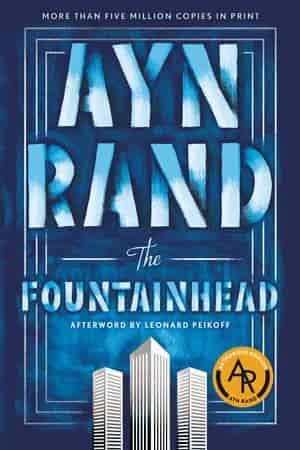
Ayn Rand
Quotes
"It's said that the worst thing one can do to a man is to kill his self-respect. But that's not true. Self-respect is something that can't be killed. The worst thing is to kill a man's pretense at it."
p. 427
"Now, talk. Talk about the things you really want said. Don't tell me about your family, your childhood, your friends or your feelings. Tell me about the things you think."
Mallory looked at him incredulously and whispered:
"How did you know that?"
Roark smiled and said nothing.
"How did you know what's been killing me? Slowly, for years, driving me to hate people when I don't want to hate.... Have you felt it, too? Have you seen how your best friends love everything about you—except the things that count? And your most important is nothing to them, nothing, not even a sound they can recognize. You mean, you want to hear? You want to know what I do and why I do it, you want to know what I think? It's not boring to you? It's important?"
"Go ahead," said Roark.
Then he sat for hours, listening, while Mallory spoke of his work, of the thoughts behind his work, of the thoughts that shaped his life, spoke gluttonously, like a drowning man flung out to shore, getting drunk on huge, clean snatches of air.
p. 351
"Every form has its own meaning. Every man creates his meaning and form and goal. Why is it so important—what others have done? Why does it become sacred by the mere fact of not being your own? Why is anyone and everyone right—so long as it's not yourself? Why does the number of those others take the place of truth? Why is truth made a mere matter of arithmetic—and only of addition at that? Why is everything twisted out of all sense to fit everything else? There must be some reason. I don't know. I've never known it. I'd like to understand."
p. 18
"You know, there's a thing that stumps me. You're the coldest man I know. And I can't understand why—knowing that you're actually a fiend in your quiet sort of way—why I always feel, when I see you, that you're the most life-giving person I've ever met."
p. 166
"Ask anything of men. Ask them to achieve wealth, fame, love, brutality, murder, self-sacrifice. But don't ask them to achieve self-respect. They will hate your soul."
p. 379
"As a matter of fact, one can feel some respect for people when they suffer. They have a certain dignity. But have you ever looked at them when they're enjoying themselves? That's when you see the truth."
p. 149
"Mr. Roark, we're alone here. Why don't you tell me what you think of me? In any words you wish. No one will hear us."
"But I don't think of you."
p. 413
"A house can have integrity, just like a person; and just as seldom."
p. 140
"I don't intend to build in order to have clients; I intend to have clients in order to build."
p. 20
"I want a good hotel, and I have certain standards of what is good, and they're my own, and you're the one who can give me what I want. And when I fight for you, I’m doing—on my side of it—just what you do when you design a building. Do you think integrity is the monopoly of the artist? And what, incidentally, do you think integrity is? The ability not to pick a watch out of your neighbor’s pocket? No, it's not as easy as that. If that were all, I'd say ninety-five percent of humanity were honest, upright men. Only, as you can see, they aren't. Integrity is the ability to stand by an idea. That presupposes the ability to think. Thinking is something one doesn't borrow or pawn. […] Don't worry. They're all against me. But I have one advantage: they don't know what they want. I do."
p. 333
"You're called a hater of humanity, Mrs. Keating, because you've committed the crime of knowing a love humanity has not learned to deserve."
p. 476
"Now take a human body. Why wouldn't you like to see a human body with a curling tail with a crest of ostrich feathers at the end? And with ears shaped like acanthus leaves? It would be ornamental, you know, instead of the stark, bare ugliness we have now. Well, why don't you like the idea? Because it would be useless and pointless. Because the beauty of the human body is that it hasn't a single muscle which doesn't serve its purpose; that there's not a line wasted; that every detail of it fits one idea, the idea of a man and the life of a man. Will you tell me why, when it comes to a building, you don't want it to look as if it had any sense or purpose, you want to choke it with trimmings, you want to sacrifice its purpose to its envelope—not knowing even why you want that kind of an envelope? You want it to look like a hybrid beast produced by crossing the bastards of ten different species until you get a creature without guts, without heart or brain, a creature all pelt, tail, claws and feathers? Why? You must tell me, because I’ve never been able to understand it."
p. 171