

Quotes
I had no idea that such individuals exist outside of stories.
The theories which I have expressed there, and which appear to you to be so chimerical, are really extremely practical — so practical that I depend upon them for my bread and cheese.
p. 23
You have been in Afghanistan, I perceive
I consider that a man's brain originally is like a little empty attic, and you have to stock it with such furniture as you choose. A fool takes in all the lumber of every sort that he comes across, so that the knowledge which might be useful to him gets crowded out, or at best is jumbled up with a lot of other things, so that he has a difficulty in laying his hands upon it. Now the skillful workman is very careful indeed as to what he takes into his brain-attic. He will have nothing but the tools which may help him in doing his work, but of these he has a large assortment, and all in the most perfect order. It is a mistake to think that this little room has elastic walls and can distend to any extent. Depend upon it, there comes a time when for any addition of knowledge, you forget something that you knew before. It is of the highest importance, therefore, not to have useless facts elbowing out the useful ones.
It is a capital mistake to theorize before you have all the evidence. It biases the judgment.
p. 27
There is no branch of detective science which is so important and so much neglected as the art of tracing footsteps.
p. 84
When a fact appears to be opposed to a long train of deductions, it invariably proves to be capable of bearing some other interpretation.
"They say that genius is an infinite capacity for taking pains," he remarked with a smile. "It's a very bad definition, but it does apply to detective work."
p. 31
His ignorance was as remarkable as his knowledge. Of contemporary literature, philosophy and politics he appeared to know nothing. Upon my quoting Thomas Carlyle, he inquired in the naivest way who he might be and what he had done. My surprise reached a climax, however, when I found incidentally that he was ignorant of the Copernican Theory and of the composition of the Solar System. That any civilized being in this nineteenth century should not be aware that the earth traveled round the sun appeared to me to be such an extraordinary fact that I could hardly realize it.
"But the Solar System!" I protested. "What the deuce is it to me?" he interrupted impatiently; "you say that we go round the sun. If we went round the moon it would not make a pennyworth of difference to me or to my work."
One's ideas must be as broad as Nature if they are to interpret Nature.
I had neither kith nor kin in England, and was therefore as free as air — or as free as an income of eleven shillings and sixpence a day will permit a man to be. Under such circumstances I naturally gravitated to London, that great cesspool into which all the loungers and idlers of the Empire are irresistibly drained. There I stayed for some time at a private hotel in the Strand, leading a comfortless, meaningless existence, and spending such money as I had, considerably more freely than I ought
p. 15
"What you do in this world is a matter of no consequence," returned my companion, bitterly. "The question is, what can you make people believe that you have done?"
p. 83
You know a conjurer gets no credit when once he has explained his trick; and if I show you too much of my method of working, you will come to the conclusion that I am a very ordinary individual after all.
p. 33
It was easier to know it than to explain why I know it. If you were asked to prove that two and two made four, you might find some difficulty, and yet you are quite sure of the fact.
p. 26
Nothing could exceed his energy when the working fit was upon him; but now and again a reaction would seize him, and for days on end he would lie upon the sofa in the sitting room, hardly uttering a word or moving a muscle from morning to night.
Before turning to those moral and mental aspects of the matter which present the greatest difficulties, let the inquirer begin by mastering more elementary problems.
p. 23
I have already explained to you that what is out of the common is usually a guide rather than a hindrance. In solving a problem of this sort, the grand thing is to be able to reason backward. That is a very useful accomplishment, and a very easy one, but people do not practice it much. In the everyday affairs of life it is more useful to reason forward, and so the other comes to be neglected. There are fifty who can reason synthetically for one who can reason analytically.
p. 83

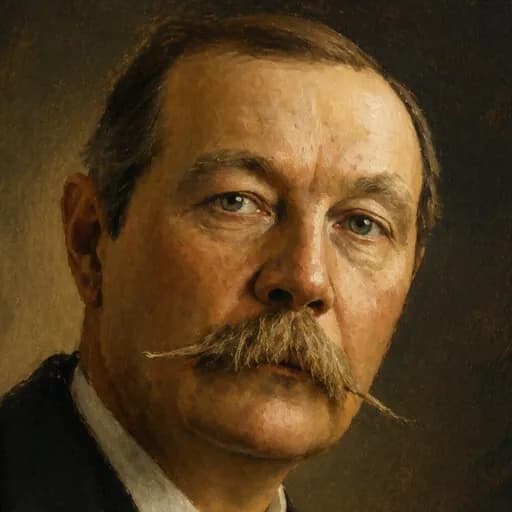


That’s all the quotes.
18 quotes in the collection · come back when we add more