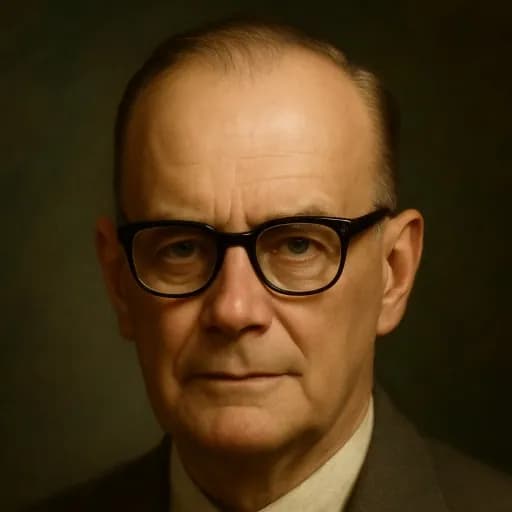
Arthur C. Clarke
Quotes
Moon-Watcher saw that his father had died in the night. He did not know that the Old One was his father, for such a relationship was utterly beyond his understanding, but as he looked at the emaciated body he felt dim disquiet that was the ancestor of sadness…He never thought of his father again.
Outside the tropics, the glaciers slew those who had prematurely left their ancestral home. But, unlike so many others, the man-apes had not merely become extinct - they had been transformed.
The toolmakers had been remade by their own tools.
A new animal was abroad on the planet, spreading slowly out from the African heartland. It was still so rare that a hasty census might have overlooked it. In the hundred thousand years since the crystals had descended upon Africa, the man-apes had invented nothing. But they had started to change, and had developed skills which no other animal possessed.
No matter how many times you left Earth, Dr. Heywood Floyd told himself, the excitement never really palled. He had been to Mars once, to the Moon three times, and to the various space stations more often than he could remember. Yet as the moment of takeoff approached, he was conscious of a rising tension, a feeling of wonder and awe - yes; and of nervousness - which put him on the same level as any Earth lubber about to receive his first baptism of space.
In a million years, the human race had lost few of its aggressive instincts; along symbolic lines visible only to politicians, the thirty-eight nuclear powers watched one another with belligerent anxiety.
Here, at the very portals of Earth, man was already face to face with a mystery that might never be solved. Three million years ago, something had passed this way, had left this unknown and perhaps unknowable symbol of its purpose, and had returned to the planets — or to the stars.
The drought had lasted now for ten million years, and the reign of the terrible lizards had long since ended. Here on the Equator, in the continent which would one day be known as Africa, the battle for existence had reached a new climax of ferocity, and the victor was not yet in sight. In this barren and desiccated land, only the small or the swift or the fierce could flourish, or even hope to survive.
The ship was still only thirty days from Earth, yet David Bowman sometimes found it hard to believe that he had ever known any other existence than the closed little world of Discovery. All his years of training, all his earlier missions to the Moon and Mars, seemed to belong to another man, in another life.
Frank Poole admitted to the same feelings, and had sometimes jokingly regretted that the nearest psychiatrist was the better part of a hundred million miles away.
Moon-Watcher had no idea of its cause, still less of its cure; but discontent had come into his soul, and he had taken one small step toward humanity.
The very atoms of his simple brain were being twisted into new patterns. If he survived, those patterns would become eternal, for his genes would pass them on to future generations.
It was a slow, tedious business, but the crystal monolith was patient. Neither it, nor its replicas scattered across half the globe, expected to succeed with all the scores of groups involved in the experiment.
When he tired of official reports, Floyd would plug his foolscap-sized News pad into the ship's information circuit. One by one he would conjure up the world's major electronic papers…He sometimes wondered if the News pad, and the fantastic technology behind it, was the last word in man's quest for perfect communications. Here he was, far out in space, speeding away from Earth at thousands of miles an hour, yet in a few milliseconds he could see the headlines of any newspaper he pleased. (That very word "newspaper," of course, was an anachronistic hangover into the age of electronics.) It was hard to imagine how the system could be improved or made more convenient. But sooner or later, Floyd guessed, it would pass away, to be replaced by something as unimaginable as the News pad itself would have been to Caxton or Gutenberg.
After three million years of darkness, TMA-1 had greeted the lunar dawn.