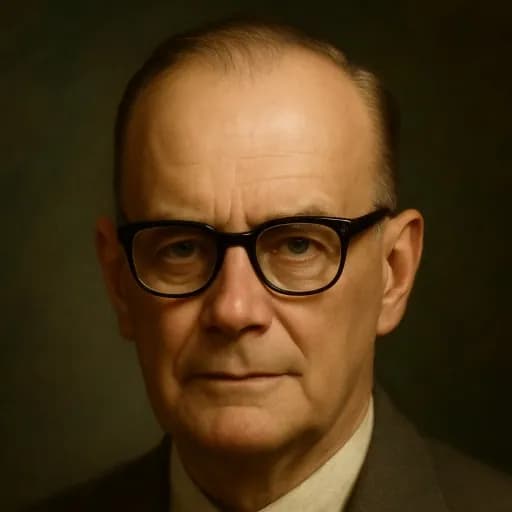
The very atoms of his simple brain were being twisted into new patterns. If he survived, those patterns would… — Arthur C. Clarke
The very atoms of his simple brain were being twisted into new patterns. If he survived, those patterns would become eternal, for his genes would pass them on to future generations.
It was a slow, tedious business, but the crystal monolith was patient. Neither it, nor its replicas scattered across half the globe, expected to succeed with all the scores of groups involved in the experiment.
Source: Wikiquote · CC BY-SA 4.0

More from this book
Could any technology, no matter how advanced, bridge the awful gulf what lay between the Solar System and the nearest alien sun? Many scientists flatly denied the possibility.
A vocal minority refused to agree. Even if it took centuries to travel from star to star, they contended, this might be no obstacle to sufficiently determined explorers…In any event, why should one assume that all intelligent species were as short-lived as Man? There might be creatures in the universe to whom a thousand-year voyage would present nothing worse than slight boredom.
Fifty years ago, Bowman would have been considered a specialist in applied astronomy, cybernetics, and space propulsion systems — yet he was prone to deny, with genuine indignation, that he was a specialist at all. Bowman had never found it possible to focus his interest exclusively on any subject; despite the dark warnings of his instructors, he had insisted on taking his Master's degree in General Astronautics — a course with a vague and woolly syllabus, designed for those whose IQs were in the low 130s and who would never reach the top ranks of their profession.
His decision had been right; that very refusal to specialize had made him uniquely qualified for his present task.
Although Bowman was nominal Captain on this phase of the mission, no outside observer could have deduced the fact. He and Poole switched roles, rank, and responsibilities completely every twelve hours. This kept them both at peak training, minimized the chances of friction, and helped toward the goal of 100 percent redundancy.