Quotes
Remember that government doesn't earn one single dollar it spends. In order for you to get money from the government, that money must first be taken from somebody else.
An area in which more rather than less government involvement is needed, in my judgment, is the rooting out of fraud. It is the bane of any market system.
p. 375
In general, corruption tends to exist whenever governments have favors to extend, or something to sell.
p. 275
Subsidiarity is the principle that government works best — most responsibly and responsively — when it is closest to the people it serves and the needs it addresses. Fiscal accountability is the principle that institutions collecting and disbursing taxes work most responsibly when they are transparent to those providing the money.
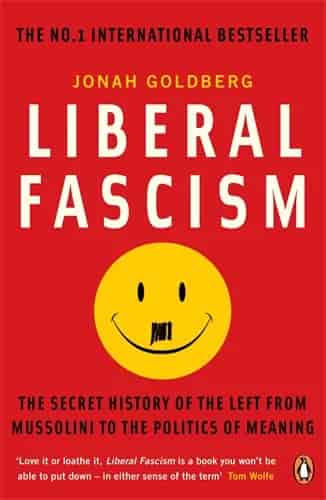
Fascism is a religion of the state. It assumes the organic unity of the body politic and longs for a national leader attuned to the will of the people. It is totalitarian in that it views everything as political and holds that any action by the state is justified to achieve the common goal. It takes responsibility for all aspects of life, including our health and well-being, and seeks to impose uniformity of thought and action, whether by force or through regulation and social pressure. Everything, including economy and religion, must be aligned with its objectives. Any rival identity is part of the "problem" and therefore defined as the enemy. I will argue that contemporary American liberalism embodies all of these aspects of fascism... You can see why the Marxist left would resist the idea that Hitler was a revolutionary. Because if he was, then either Hitler was a force for good, or revolutions can be bad.
p. 63
" […] the only way in which we can have any law at all is to have as little of it as possible. I see no ethical standard by which to measure the whole unethical conception of a State, except in the amount of time, of thought, of money, of effort and of obedience, which a society extorts from its every member. Its value and its civilization are in inverse ratio to that extortion. There is no conceivable law by which a man can be forced to work on any terms except those he chooses to set. There is no conceivable law to prevent him from setting them—just as there is none to force his employer to accept them. The freedom to agree or disagree is the foundation of our kind of society—and the freedom to strike is a part of it."
p. 110
A man who doesn’t detest a bad government is a fool. And if there were such a thing as a good government on earth, it would be a great joy to serve it.
p. 213
"By this action, the Government has proved that so long as it exists, none of us are truly free. Government and freedom are mutually exclusive. So if we value freedom, there's only one conclusion. It's time to get rid of this leftover relic we call Government."
p. 202
From the cradle to the grave all our actions are guided by this principle. Open any book on sociology or jurisprudence, and you will find there the Government, its organization, its acts, filling so large a place that we ome to believe that there is nothing outside the Government and the world of statesmen.
p. 79
Accustomed as we are by hereditary prejudices an absolutely unsound education and training to see Government, legislation and magistracy everywhere around, we have come to believe that man would tear his fellow man to pieces like a wild beast the day the police took his eye off him; that chaos would come about if authority were overthrown during a revolution. And with out eyes shut we pass by thousands and thousands of human groupings which form themselves freely, without any intervention of the law, and attain results infinitely superior to those achieved under government tutelage.
Our Constitution, by its separation of powers and its system of checks and balances, acts as a restraint upon efficiency by denying exclusive power to any branch of government. The logic of governmental efficiency, unchecked, runs straight on, not only to dictatorship, but also to torture, assassination, and other abominations.
When the possessions and households of citizens are no longer honored by the acts, as well as the principles, of their government, then the concentration camp ceases to be one of the possibilities of human nature and becomes one of its likelihoods.