Quotes about survival
80 quotes · 63 authors
Quotes
The prisoners who saved themselves were not the best, the predestined to good, the bearers of a message: what I had seen and experienced showed the exact opposite. Survived the worst of preference, the selfish, the violent, the insensitive, the collaborators of the 'gray area', the spies. It was not a certain rule (there were, nor are there in human affairs, certain rules), but was also a rule. I felt so innocent, but trooped among the saved, and therefore constantly looking for an excuse, before me and the others. Survived the worst, that is the most suitable; the best are all dead.
"Man's mind is his basic tool of survival. Life is given to him; survival is not. His body is given to him, its sustenance is not. His mind is given to him, its contents are not. To remain alive, he must act, and before he can act he must know the nature and purpose of his action."
p. 1012
"In the end what will happen will be what has happened whenever a civilization breaks up. The people who have brains and courage come through and the ones who haven't are winnowed out. At least, it has been interesting, if not comfortable, to witness a Gotterdammerung."
Life on earth is hard. Competition for the necessities of life is fierce. How ridiculous to believe that the law of harsh survival would not be true elsewhere, or that it would be negated by the progress of technology in an advanced civilization...
p. 352
Fear is unnatural. Lightning and thunder are unnatural. Pain, death, reality, these are all unnatural. We can't bear these things as they are. We know too much. So we resort to repression, compromise and disguise. This is how we survive the universe. This is the natural language of the species.
Scars are the paler pain of survival, received unwillingly and displayed in the language of injury.
p. 130
It is not even clear that intelligence has any long-term survival value.
p. 84
I regard it as almost inevitable that either a nuclear confrontation or environmental catastrophe will cripple the Earth at some point in the next 1,000 years which, as geological time goes, is the mere blink of an eye. By then I hope and believe that our ingenious race will have found a way to slip the surly bonds of Earth and will therefore survive the disaster.
p. 150
It has certainly been true in the past that what we call intelligence and scientific discovery have conveyed a survival advantage. It is not so clear that this is still the case: our scientific discoveries may well destroy us all, and even if they don’t, a complete unified theory may not make much difference to our chances of survival. However, provided the universe has evolved in a regular way, we might expect that the reasoning abilities that natural selection has given us would be valid also in our search for a complete unified theory, and so would not lead us to the wrong conclusions.
p. 13
Because it is clear from the fossil record that almost every species that has ever existed is extinct; extinction is the rule, survival is the exception.
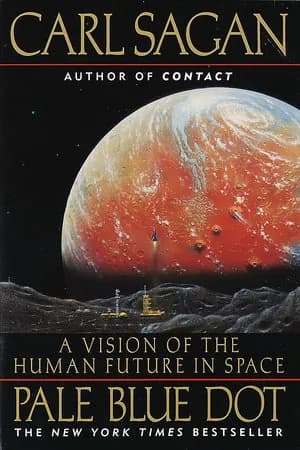
Since, in the long run, every planetary society will be endangered by impacts from space, every surviving civilization is obliged to become spacefaring — not because of exploratory or romantic zeal, but for the most practical reason imaginable: staying alive.
p. 371
For all its material advantages, the sedentary life has left us edgy, unfulfilled. Even after 400 generations in villages and cities, we haven't forgotten. The open road still softly calls, like a nearly forgotten song of childhood. We invest far-off places with a certain romance. This appeal, I suspect, has been meticulously crafted by natural selection as an essential element in our survival. Long summers, mild winters, rich harvests, plentiful game—none of them lasts forever. It is beyond our powers to predict the future. Catastrophic events have a way of sneaking up on us, of catching us unaware. Your own life, or your band's, or even your species' might be owed to a restless few—drawn, by a craving they can hardly articulate or understand, to undiscovered lands and new worlds.
Herman Melville, in Moby Dick, spoke for wanderers in all epochs and meridians: "I am tormented with an everlasting itch for things remote. I love to sail forbidden seas…"
p. 2