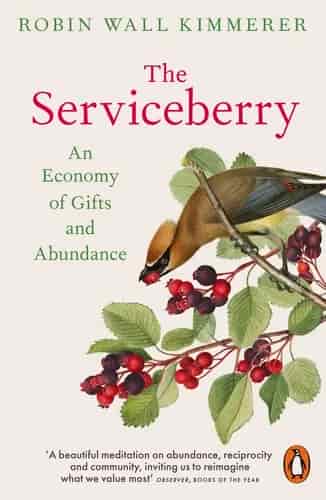
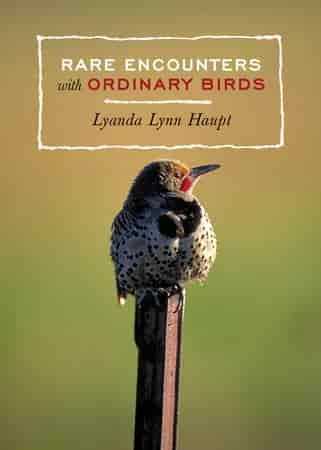
Quotes
Being a good mother means teaching your children to care for the world.
p. 95
Listening in wild places, we are audience to conversations in a language not our own.
p. 48
I like the ecological idea of aging as progressive enrichment, rather than progressive loss.
p. 86
In the Western tradition there is a recognized hierarchy of beings, with, of course, the human being on top—the pinnacle of evolution, the darling of Creation—and the plants at the bottom. But in Native ways of knowing, human people are often referred to as "the younger brothers of Creation." We say that humans have the least experience with how to live and thus the most to learn—we must look to our teachers among the other species for guidance. Their wisdom is apparent in the way that they live. They teach us by example. They've been on the earth far longer than we have been, and have had time to figure things out.
p. 9
Water, land, and even a day, the language a mirror for seeing the animacy of the world, the life that pulses through all things, through pines and nuthatches and mushrooms. This is the language I hear in the woods; this is the language that lets us speak of what wells up all around us.
p. 55
Look at the legacy of poor Eve's exile from Eden: the land shows the bruises of an abusive relationship. It’s not just land that is broken, but more importantly, our relationship to land.
p. 9
We Americans are reluctant to learn a foreign language of our own species, let alone another species. But imagine the possibilities. Imagine the access we would have to different perspectives, the things we might see through other eyes, the wisdom that surrounds us. We don’t have to figure out everything by ourselves: there are intelligences other than our own, teachers all around us. Imagine how much less lonely the world would be.
p. 58
What else can you offer the earth, which has everything? What else can you give but something of yourself? A homemade ceremony, a ceremony that makes a home.
p. 38
We spill over into the world and the world spills over into us. The earth, that first among good mothers, gives us the gift that we cannot provide ourselves.
p. 103
The guidelines of the Honorable Harvest are not usually written down, they are reinforced in small acts of daily life. But if I were to list them they would look something like this:
Know the ways of the ones who take care of you, so that you can take care of them.
Introduce yourself. Be accountable as the one who comes asking for a life.
Ask permission before taking. Abide by the answer.
Never take the first one. Never take the last.
Take only what you need.
Take only that which is given.
Never take more than half. Leave some for others.
Harvest in a way that minimizes harm.:
Use it respectfully. Never waste what you have taken.
Share.
Give thanks for what you have been given.
Give a gift in reciprocity for what you have taken.
Sustain the ones who sustain you and the Earth will last forever.
I suppose it might be argued that, for the amateur watcher seeking a meaningful connection with birds, this attention to remote detail is just another form of scientific reductionism, that harried foe of poetry and wonder. In my experience, it is so much the opposite. The tinier the details I come to comprehend, the more bewildered I become, the richer, it seems, the more inspiring of awe, is the biological life I manage to encounter.
The minutiae offer a focus that bridges the aesthetic and scientific worlds.
p. 83
Why do men always want to tamper with the natural order of things?
“When something breaks, we fix it, that’s all.”
What gave you the absurd idea that [the world]’s broken?
“It’s not the way it was before, Em. To our way of looking at things, that means that it’s broken.”
[...]
Change doesn’t necessarily mean improvement, Althalus. Change is just change. “Better” and “worse” are human definitions. The world changes all the time, and no amount of complaining’s going to stop it from changing.