Quotes
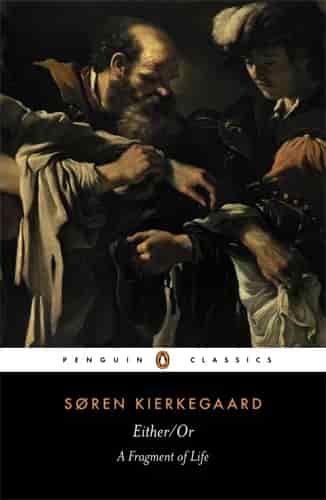
A young swain falls in love with a princess,29 and the whole content of his life consists in this love, and yet the situation is such that it is impossible for it to be realized, impossible for it to be translated from ideality into reality. The slaves of paltriness, the frogs in life's swamp, will naturally cry out, "Such a love is foolishness. The rich brewer's widow is a match fully as good and respectable." Let them croak in the swamp undisturbed.
When the child must be weaned, the mother blackens her breast, it would indeed be a shame that the breast should look delicious when the child must not have it. So the child believes that the breast has changed, but the mother is the same, her glance is as loving and tender as ever. Happy the person who had no need of more dreadful expedients for weaning the child !
No, not one shall be forgotten who was great in the world. But each was great in his own way, and each in proportion to the greatness of that which he loved. For he who loved himself became great by himself, and he who loved other men became great by his selfless devotion, but he who loved God became greater than all. Everyone shall be remembered, but each became great in proportion to his expectation. One became great by expecting the possible, another by expecting the eternal, but he who expected the impossible became greater than all. Everyone shall be remembered, but each was great in proportion to the greatness of that with which he strove. For he who strove with the world became great by overcoming the world, and he who strove with himself became great by overcoming himself, but he who strove with God became greater than all. So there was strife in the world, man against man, one against a thousand, but he who strove with God was greater than all. So there was strife upon earth : there was one who overcame all by his power, and there was one who overcame God by his impotence. There was one who relied upon himself and gained all, there was one who secure in his strength sacrificed all, but he who believed God was greater than all. There was one who was great by reason of his power, and one who was great by reason of his wisdom, and one who was great by reason of his hope, and one who was great by reason of his love ; but Abraham was greater than all, great by reason of his power whose strength is impotence, great by reason of his wisdom whose secret is foolishness, great by reason of his hope whose form is madness, great by reason of the love which is hatred of oneself.
p. 31
Love means to look at yourself
The way one looks at distant things
For you are only one thing among many.
And whoever sees that way heals his heart,
Without knowing it, from various ills —
A bird and a tree say to him: Friend.
There is nothing more dangerous to me than remembering. The moment I have remembered some life-relationship that moment it ceased to exist. People say that separation, tends to revive love. Quite true, but it revives it in a purely poetic manner. The life that is lived wholly in memory is the most perfect conceivable, the satisfactions of memory are richer than any reality, and have a security that in no reality possesses. A remembered life-relations has already passed into eternity, and ha no more temporal interest.
p. 32
True love, like any other strong and addicting drug, is boring—once the tale of encounter and discovery is told, kisses quickly grow stale and caresses tiresome... except, of course, to those who share the kisses, who give and take the caresses while every sound and color of the world seems to deepen and brighten around them. As with any other strong drug, true first love is really only interesting to those who have become its prisoners.
If you love me, then love me.
Keep my love safe; take my love safe to where he goes, give him joy in who he sees, and make him a cause of joy in those who see him.
“I love you, Eddie. You have tried so hard. Been so patient. So has he—” she nodded toward the place where the gunslinger lay propped against the rocks, watching. “– but he is a hard man to love.”
If you have given up your heart for the Tower, Roland, you have already lost. A heartless creature is a loveless creature, and a loveless creature is a beast. To be a beast is perhaps bearable, although the man who has become one will surely pay hell’s own price in the end, but if you should gain your object? What if you should, heartless, storm the Dark Tower and win it? What could you do except degenerate from beast to monster? To gain one’s object as a beast would only be bitterly comic, like giving a magnifying glass to an elephaunt. But to gain one’s object as a monster…To pay hell is one thing. But do you want to own it?
Pity and love know little severance. One attends the other. (Chapter I)
love — that arbitrary and inexorable tyrant. (Chapter XII)