Quotes
There was more known, but always more to be known.
Yes, she thought, and the unknown can masquerade as the unknowable.
p. 212
Archeology is mostly a process of making associations between objects, and every discovery opens up possible resonances with things we already have. Sometimes, simply wandering through a museum or a site can open your eyes.
p. 107
The face of the water, in time, became a wonderful book — a book that was a dead language to the uneducated passenger, but which told its mind to me without reserve, delivering its most cherished secrets as clearly as if it uttered them with a voice. And it was not a book to be read once and thrown aside, for it had a new story to tell every day.
No, the romance and beauty were all gone from the river. All the value any feature of it had for me now was the amount of usefulness it could furnish toward compassing the safe piloting of a steamboat. Since those days, I have pitied doctors from my heart. What does the lovely flush in a beauty's cheek mean to a doctor but a "break" that ripples above some deadly disease? Are not all her visible charms sown thick with what are to him the signs and symbols of hidden decay? Does he ever see her beauty at all, or doesn't he simply view her professionally, and comment upon her unwholesome condition all to himself? And doesn't he sometimes wonder whether he has gained most or lost most by learning his trade?
It was a vast open marketplace with thousands of stalls, filled with carts and runners carrying product in all directions. But no vegetables, fish, spices, or fodder were to be seen here; all the product was information written down in books.... Book-carriers bumped into each other, compared notes as to what they were carrying and where they were going, and swapped books for other books. Stacks of books were sold in great, raucous auctions—and paid for not with gold but with other books. Around the edges of the market were stalls where books were exchanged for gold, and beyond that, a few alleys where gold could be exchanged for food.
The world is a never-ending cross-reference.
If the item of stolen property had been anything other than a book, it would have been confiscated. But a book is different—it is not just a material possession but the pathway to an enlightened mind, and thence to a well-ordered society, as the Master stated many times.
Do you need more knowledge? Is more information going to save the world, or faster computers, more scientific or intellectual analysis? Is it not wisdom that humanity needs most at this time? But what is wisdom and where is it to be found? Wisdom comes with the ability to be still. Just look and just listen. No more is needed. Being still, looking, and listening activates the non-conceptual intelligence within you. Let stillness direct your words and actions. (Ch 1)
It’s a big coincidence. It’s something we can’t explain. But as far as we know that’s all it is. And if it isn’t, we’ll only find out by discovering more facts, not speculating, no matter how logical that speculation might seem. The way to learn the world is to look at the world.
p. 148
The poor dear cannot differentiate between erudition and wisdom.
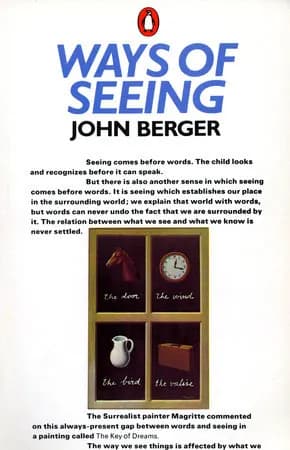
Seeing comes before words. The child looks and recognizes before it can speak.
But there is also another sense in which seeing comes before words. It is seeing which establishes our place in the surrounding world; we explain that world with words, but words can never undo the fact that we are surrounded by it. The relation between what we see and what we know is never settled.
Some speak of things we know, as new;
And you, of things unknown as things forgot.
p. 279