Quotes about individualism
62 quotes · 35 authors
Quotes
“People like your wife are dangerous.”
“Why?” Hamilton asked.
“They don’t belong to any group. They fool around with everything. As soon as we turn our back—”
“So you destroy them. You turn them over to the lunatic patriots.”
“The lunatic patriots,” McFeyffe said, “we can understand. But not your wife. She signs Party peace petitions and she reads the Chicago Tribune. People like her—they’re more of a menace to Party discipline than any other bunch. The cult of individualism. The idealist with his own law, his own ethics. Refusing to accept authority. It undermines society. It topples the whole structure. Nothing lasting can be built on it. People like your wife just won’t take orders.”
p. 231
When law and duty are one, united by religion, you never become fully conscious, fully aware of yourself. You are always a little less than an individual.
“There is considerable hypocrisy in conventionalism. Any thinking person is aware of this paradox; but in dealing with conventional people it is advantageous to treat them as though they were not hypocrites. It isn't a question of faithfulness to your own concepts; it is a matter of compromise so that you can remain an individual without the constant threat of conventional pressures.”
It does seem to me, that herein we see the rare virtue of a strong individual vitality, and the rare virtue of thick walls, and the rare virtue of interior spaciousness. Oh, man! admire and model thyself after the whale! Do thou, too, remain warm among ice. Do thou, too, live in this world without being of it. Be cool at the equator; keep thy blood fluid at the Pole. Like the great dome of St. Peter's, and like the great whale, retain, O man! in all seasons a temperature of thine own. But how easy and how hopeless to teach these fine things! Of erections, how few are domed like St. Peter's! of creatures, how few vast as the whale!
p. 343
Not only does democracy make every man forget his ancestors, but also clouds their view of their descendants and isolates them from their contemporaries. Each man is for ever thrown back on himself alone, and there is danger that he may be shut up in the solitude of his own heart.
My personal feeling is that this is how any further improvement of the world will be done: by individuals making Quality decisions and that's all. God, I don't want to have any more enthusiasm for big programs full of social planning for big masses of people that leave individual Quality out. These can be left alone for a while. There's a place for them but they've got to be built on a foundation of Quality within the individuals involved. We've had that individual Quality in the past, exploited it as a natural resource without knowing it, and now it's just about depleted. Everyone's just about out of gumption. And I think it's about time to return to the rebuilding of this American resource—individual worth. There are political reactionaries who've been saying something close to this for years. I'm not one of them, but to the extent they're talking about real individual worth and not just an excuse for giving more money to the rich, they're right. We do need a return to individual integrity, self-reliance and old-fashioned gumption. We really do.
For everyone strives to keep his individuality as apart as possible, wishes to secure the greatest possible fullness of life for himself; but meantime all his efforts result not in attaining fullness of life but self-destruction, for instead of self-realisation he ends by arriving at complete solitude. All mankind in our age have split up into units, they all keep apart, each in his own groove; each one holds aloof, hides himself and hides what he has, from the rest, and he ends by being repelled by others and repelling them. He heaps up riches by himself and thinks, ‘How strong I am now and how secure,’ and in his madness he does not understand that the more he heaps up, the more he sinks into self-destructive impotence. For he is accustomed to rely upon himself alone and to cut himself off from the whole; he has trained himself not to believe in the help of others, in men and in humanity, and only trembles for fear he should lose his money and the privileges that he has won for himself. Everywhere in these days men have, in their mockery, ceased to understand that the true security is to be found in social solidarity rather than in isolated individual effort. But this terrible individualism must inevitably have an end, and all will suddenly understand how unnaturally they are separated from one another. It will be the spirit of the time, and people will marvel that they have sat so long in darkness without seeing the light.
he follows no rule, submits to no authority, copies no pattern, and only acts or speaks as he pleases. So do not expect set speeches or studied manners from him, but just the faithful expression of his thoughts and the conduct that springs from his inclinations.
A man, in so far as he is an individual, may be very sharply detached from others, a sort of spiritual crustacean, and yet be very poor in differentiating content. And further, it is true on the other hand that the more personality a man has and the greater his interior riches and the more he is a society within himself, the less brusquely he is divided from his fellows.
I must avert here once again to my view of the opposition that exists between individuality and personality, notwithstanding the fact that the one demands the other. Individuality is, if I may so express it, the container or thing which contains, personality the content or thing contained, or I might say that my personality is in a certain sense my comprehension, that which I comprehend or embrace within myself — which is in a certain way the whole Universe — and that my individuality is my extension; the one my infinite, the other my finite.
Individuality of expression is the beginning and end of all art.
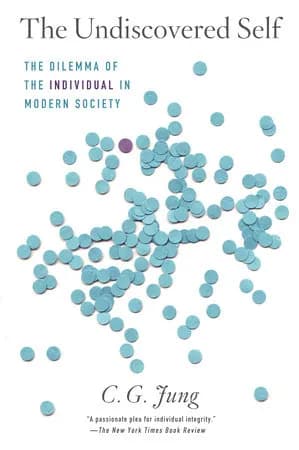
The bigger the crowd, the more negligible the individual.
p. 14