Quotes about children
263 quotes · 149 authors
Quotes
When we review with the child the productions of art and nature, when we stimulate his curiosity and follow its lead, we have great opportunities of studying his tastes and inclinations, and perceiving the first spark of genius, if he has any decided talent in any direction. You must, however, be on your guard against the common error which mistakes the effects of environment for the ardour of genius, or imagines there is a decided bent towards any one of the arts, when there is nothing more than that spirit of emulation, common to men and monkeys, which impels them instinctively to do what they see others doing, without knowing why. The world is full of artisans, and still fuller of artists, who have no native gift for their calling, into which they were driven in early childhood, either through the conventional ideas of other people, or because those about them were deceived by an appearance of zeal, which would have led them to take to any other art they saw practised. One hears a drum and fancies he is a general; another sees a building and wants to be an architect. Every one is drawn towards the trade he sees before him if he thinks it is held in honour.
Is there anything better worth seeing, anything more touching or more delightful, than a pretty child, with merry, cheerful glance, easy contented manner, open smiling countenance, playing at the most important things, or working at the lightest amusements?
I do not mean to say that he will never do any mischief, never hurt himself, never break a costly ornament if you leave it within his reach. He might do much damage without doing wrong, since wrong-doing depends on the harmful intention which will never be his. If once he meant to do harm, his whole education would be ruined; he would be almost hopelessly bad.
The child is usually much quicker to read the master's thoughts than the master to read the child's feelings. And that is as it should be, for all the sagacity which the child would have devoted to self-preservation, had he been left to himself, is now devoted to the rescue of his native freedom from the chains of his tyrant; while the latter, who has no such pressing need to understand the child, sometimes finds that it pays him better to leave him in idleness or vanity.
Silly children grow into ordinary men. I know no generalisation more certain than this. It is the most difficult thing in the world to distinguish between genuine stupidity, and that apparent and deceitful stupidity which is the sign of a strong character. At first sight it seems strange that the two extremes should have the same outward signs; and yet it may well be so, for at an age when man has as yet no true ideas, the whole difference between the genius and the rest consists in this: the latter only take in false ideas, while the former, finding nothing but false ideas, receives no ideas at all. In this he resembles the fool; the one is fit for nothing, the other finds nothing fit for him. The only way of distinguishing between them depends upon chance, which may offer the genius some idea which he can understand, while the fool is always the same. As a child, the young Cato was taken for an idiot by his parents; he was obstinate and silent, and that was all they perceived in him; it was only in Sulla's ante-chamber that his uncle discovered what was in him. Had he never found his way there, he might have passed for a fool till he reached the age of reason. Had Caesar never lived, perhaps this same Cato, who discerned his fatal genius, and foretold his great schemes, would have passed for a dreamer all his days. Those who judge children hastily are apt to be mistaken; they are often more childish than the child himself.
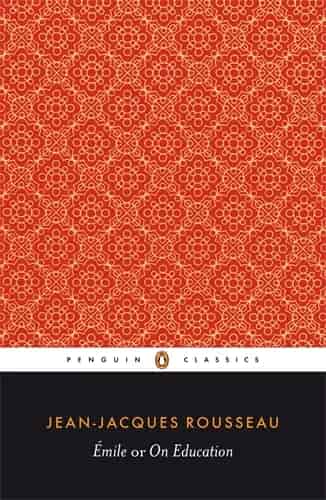
Emile will not learn anything by heart, not even fables, not even the fables of La Fontaine, simple and delightful as they are, for the words are no more the fable than the words of history are history. How can people be so blind as to call fables the child's system of morals, without considering that the child is not only amused by the apologue but misled by it? He is attracted by what is false and he misses the truth, and the means adopted to make the teaching pleasant prevent him profiting by it. Men may be taught by fables; children require the naked truth.
He who feels the need of help from others, he who is constantly experiencing their kindness, has nothing to gain by deceiving them; it is plainly to his advantage that they should see things as they are, lest they should mistake his interests. It is therefore plain that lying with regard to actual facts is not natural to children, but lying is made necessary by the law of obedience; since obedience is disagreeable, children disobey as far as they can in secret, and the present good of avoiding punishment or reproof outweighs the remoter good of speaking the truth. Under a free and natural education why should your child lie? What has he to conceal from you? You do not thwart him, you do not punish him, you demand nothing from him. Why should he not tell everything to you as simply as to his little playmate?
Children's lies are therefore entirely the work of their teachers, and to teach them to speak the truth is nothing less than to teach them the art of lying. In your zeal to rule, control, and teach them, you never find sufficient means at your disposal. You wish to gain fresh influence over their minds by baseless maxims, by unreasonable precepts; and you would rather they knew their lessons and told lies, than leave them ignorant and truthful.
Let us lay it down as an incontrovertible rule that the first impulses of nature are always right; there is no original sin in the human heart, the how and why of the entrance of every vice can be traced. The only natural passion is self-love or selfishness taken in a wider sense. This selfishness is good in itself and in relation to ourselves; and as the child has no necessary relations to other people he is naturally indifferent to them; his self-love only becomes good or bad by the use made of it and the relations established by its means.
It is maintained that unswaddled infants would assume faulty positions and make movements which might injure the proper development of their limbs. That is one of the empty arguments of our false wisdom which has never been confirmed by experience. Out of all the crowds of children who grow up with the full use of their limbs among nations wiser than ourselves, you never find one who hurts himself or maims himself; their movements are too feeble to be dangerous, and when they assume an injurious position, pain warns them to change it.
We can do nothing simply, not even for our children. Toys of silver, gold, coral, cut crystal, rattles of every price and kind; what vain and useless appliances. Away with them all! Let us have no corals or rattles; a small branch of a tree with its leaves and fruit, a stick of liquorice which he may suck and chew, will amuse him as well as these splendid trifles, and they will have this advantage at least, he will not be brought up to luxury from his birth.
Nature provides for the child's growth in her own fashion, and this should never be thwarted. Do not make him sit still when he wants to run about, nor run when he wants to be quiet. If we did not spoil our children's wills by our blunders their desires would be free from caprice. Let them run, jump, and shout to their heart's content. All their own activities are instincts of the body for its growth in strength; but you should regard with suspicion those wishes which they cannot carry out for themselves, those which others must carry out for them. Then you must distinguish carefully between natural and artificial needs, between the needs of budding caprice and the needs which spring from the overflowing life just described.
This results from the fact that, up to five or six, children in town, brought up in a room and under the care of a nursery governess, do not need to speak above a whisper to make themselves heard. As soon as their lips move people take pains to make out what they mean; they are taught words which they repeat inaccurately, and by paying great attention to them the people who are always with them rather guess what they meant to say than what they said. It is quite a different matter in the country. A peasant woman is not always with her child; he is obliged to learn to say very clearly and loudly what he wants, if he is to make himself understood. Children scattered about the fields at a distance from their fathers, mothers and other children, gain practice in making themselves heard at a distance, and in adapting the loudness of the voice to the distance which separates them from those to whom they want to speak. This is the real way to learn pronunciation, not by stammering out a few vowels into the ear of an attentive governess. So when you question a peasant child, he may be too shy to answer, but what he says he says distinctly, while the nurse must serve as interpreter for the town child; without her one can understand nothing of what he is muttering between his teeth.
I grant you uneducated people and villagers often fall into the opposite extreme. They almost always speak too loud; their pronunciation is too exact, and leads to rough and coarse articulation; their accent is too pronounced, they choose their expressions badly, etc. But, to begin with, this extreme strikes me as much less dangerous than the other, for the first law of speech is to make oneself understood, and the chief fault is to fail to be understood. To pride ourselves on having no accent is to pride ourselves on ridding our phrases of strength and elegance. Emphasis is the soul of speech, it gives it its feeling and truth. Emphasis deceives less than words; perhaps that is why well-educated people are so afraid of it. From the custom of saying everything in the same tone has arisen that of poking fun at people without their knowing it.