Quotes about capitalism
65 quotes · 35 authors
Quotes
In virtue of this monstrous system, the son of the worker, on entering life, finds no field which he may till, no machine which he may tend, no mine in which he may dog, without accepting to leave a great part of what he will produce to a master.
p. 59
After World War II, we hoped the world might be united for the sake of peacemaking. Now the world is being "globalized" for the sake of trade and the so-called free market — for the sake, that is, of plundering the world for cheap labor, cheap energy, and cheap materials. How nations, let alone regions and communities, are to shape and protect themselves within this "global economy" is far from clear.
Let us have the candor to acknowledge that what we call “the economy” or “the free market” is less and less distinguishable from warfare. For about half of the last century, we worried about world conquest by international communism. Now with less worry (so far) we are witnessing world conquest by international capitalism. Though its political means are milder (so far) than those of communism, this newly internationalized capitalism may prove even more destructive of human cultures and communities, of freedom, and of nature. Its tendency is just as much toward total dominance and control.
By this time, the era of cut-and-run economics ought to be finished. Such an economy cannot be rationally defended or even apologized for. The proofs of its immense folly, heartlessness, and destructiveness are everywhere. Its failure as a way of dealing with the natural world and human society can no longer be sanely denied. That this economic system persists and grows larger and stronger in spite of its evident failure has nothing to do with rationality or, for that matter, with evidence. It persists because, embodied now in multinational corporations, it has discovered a terrifying truth: If you can control a people’s economy, you don’t need to worry about its politics; its politics have become irrelevant. If you control people’s choices as to whether or not they will work, and where they will work, and what they will do, and how well they will do it, and what they will eat and wear, and the genetic makeup of their crops and animals, and what they will do for amusement, then why should you worry about freedom of speech? In a totalitarian economy, any "political liberties" that the people might retain would simply cease to matter. If, as is often the case already, nobody can be elected who is not wealthy, and if nobody can be wealthy without dependence on the corporate economy, then what is your vote worth? The citizen thus becomes an economic subject.
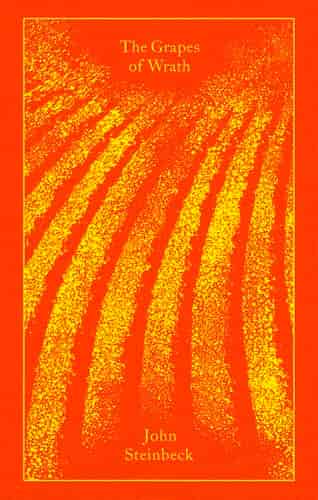
The bank is something else than men. It happens that every man in a bank hates what the bank does, and yet the bank does it. The bank is something more than men, I tell you. It's the monster. Men made it, but they can't control it.
If a bank or a finance company owned the land, the owner man said, The Bank — or the Company — needs — wants — insists — must have — as though the Bank or the Company were a monster, with thought and feeling, which had ensnared them. These last would take no responsibility for the banks or the companies because they were men and slaves, while the banks were machines and masters all at the same time. Some of the owner men were a little proud to be slaves to such cold and powerful masters.
Lenin is said to have declared that the best way to destroy the capitalist system was to debauch the currency. By a continuing process of inflation, governments can confiscate, secretly and unobserved, an important part of the wealth of their citizens. By this method they not only confiscate, but they confiscate arbitrarily; and, while the process impoverishes many, it actually enriches some. The sight of this arbitrary rearrangement of riches strikes not only at security, but at confidence in the equity of the existing distribution of wealth. Those to whom the system brings windfalls, beyond their deserts and even beyond their expectations or desires, become 'profiteers,' who are the object of the hatred of the bourgeoisie, whom the inflationism has impoverished, not less than of the proletariat. As the inflation proceeds and the real value of the currency fluctuates wildly from month to month, all permanent relations between debtors and creditors, which form the ultimate foundation of capitalism, become so utterly disordered as to be almost meaningless; and the process of wealth-getting degenerates into a gamble and a lottery.
Lenin was certainly right. There is no subtler, no surer means of overturning the existing basis of society than to debauch the currency. The process engages all the hidden forces of economic law on the side of destruction, and does it in a manner which not one man in a million is able to diagnose.
p. 235
The immense accumulations of fixed capital which, to the great benefit of mankind, were built up during the half century before the war, could never have come about in a Society where wealth was divided equitably.
p. 19
I seek only to point out that the principle of accumulation based on inequality was a vital part of the pre-war order of Society and of progress as we then understood it, and to emphasize that this principle depended on unstable psychological conditions, which it may be impossible to recreate. It was not natural for a population, of whom so few enjoyed the comforts of life, to accumulate so hugely. The war has disclosed the possibility of consumption to all and the vanity of abstinence to many. Thus the bluff is discovered; the labouring classes may be no longer willing to forgo so largely, and the capitalist classes, no longer confident of the future, may seek to enjoy more fully their liberties of consumption so long as they last, and thus precipitate the hour of their confiscation.
The irony is that in our decades, the combination of rationalism, asceticism, and individualism (the so-called Protestant Ethic) has produced precisely the system of boondoggling, luxury-consumption, and status.
p. 143
The ideal of having a real job that you risk your soul in and make good or be damned, belongs to the heroic age of capitalist enterprise, imbued with self-righteous beliefs about hard work, thrift, and public morals. Such an ideal might still have been mentioned in public fifty years ago; in our era of risk-insured semimonopolies and advertised vices it would be met with a ghastly stillness.
p. 36
It's universally wrong to steal from your neighbor, but once you get beyond the-one-to-one level and pit the individual against the multinational conglomerate, the federal bureaucracy, the modern plantation of agro-buinsess, or the utility company, it becomes strictly a value judgement to decide exactly who is stealing from whom. One person's crime is another person's profit. Capitalism is license to steal; the government simply regulates who steals an how much. I always wanted to put together an outlaw handbook that would help raise consciousness on these points while doing something about evening the score. There was also the challenge of testing the limits of free speech.