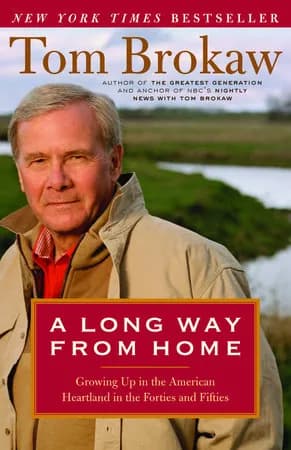
Tom Brokaw
Quotes
I am a child of the American men and women who grew up in the Great Depression, who came of age in World War II and then devoted their adult years to the building of modern America- the remarkable people I wrote about in The Greatest Generation. As I walked the beaches of Normandy on the fortieth and fiftieth anniversaries of D-Day, I first began to fully realize how they had shaped my life. They were my parents and the parents of my friends, teachers, ministers, physicians, and hometown merchants, the men and women who showed me the way through their own exacting standards of hard work, sacrifice, and personal responsibility. I began to understand how much I owed them.
There is no world war to fight today nor any prospect of one anytime soon, but racial discrimination remains an American cancer. There is no Great Depression, but economic opportunity is an unending challenge, especially in a high-tech world where education is more important than ever. Most of all, there is the need to reinstate the concept of common welfare in America, so that the nation doesn't squander the legacy of this remarkable generation by becoming a collection of well-defined, narrowly-cast, special-interest fiefdoms, each concerned only with its own place in the mosaic. World War II and what came after was the result of a nation united, not a nation divided.
p. 388
This is a book crafted by many memories, youthful insights, and the wisdom that come with seasons of despair and triumph. It is, most of all, another tribute to the men and women who rode the teacherous currents and sailed with the fair winds of most of the twentieth century.
It is not surprising, I suppose, that the horrors of war give birth to a new generation of good Samaritans. Young men and women who have been so intensely exposed to such inhumanity often make a silent pledge that if they ever escape this dark world of death and injuries, this universe of cruelty, they will devote their lives to good works. Sometimes the pledge is a conscious thought. Sometimes it is a subconscious reaction to their experiences.
p. 26
A new generation of Americans has a greater appreciation of what was involved on D-Day as a result of Steven Spielberg's stunning film Saving Private Ryan. For most younger Americans, D-Day has been a page or two in their history books, or some anniversary ceremony on television with a lot of white-haired men leaning into the winds coming off the English Channel as President Reagan or President Clinton praised their contributions. Saving Private Ryan, although a work of fiction, is true to the sound, the fury, the death, the terrible wounds of that day.
p. 27
After talking to so many of them and reflecting on what they have meant in my own life, I now know that it is in these small ceremonies and quiet moments that this generation is appropriately honored. No fanfare is required. They've had their parades. They've heard their speeches. They know what they have accomplished, and they are proud. They will have their World War II memorial and their place in the ledgers of history, but no block of marble or elaborate edifice can equal their lives of sacrifices and achievement, duty and honor, as monuments to their time.
p. 290
"Hero" is a description tossed around lightly these days- like "star" or "celebrity"- another significant difference between the closing days of the twentieth century and the century's middle years, World War II. During the war the use of the phrase "You're a hero" was likely to bring on the quick rejoinder, "No, I'm not; I'm just doing my job here- like everyone else." The fighting men and women were so dependent on each other and shared so many common experiences they were embarrassed to be singled out.
Some acts of heroism, however, were so breathtakingly conspicuous, so daring and vital to the military mission, they could not be overlooked or turned aside. In many instances they changed forever the lives of those who were decorated. Others who were decorated returned to the lives they would have had without the medal and the attention.
If there is a common thread among the major medal winners, it is the same modesty expressed by Army nurse Mary Louise Roberts Wilson when she received the Silver Star. Almost to a person they have said to me, "I didn't win this medal. I merely accepted it for all the people who were with me." Nevertheless, they did win it, and the very qualities that led them to take great risks to save others served them well once they returned home.
p. 103
When I first came to fully understand what effect members of the World War II generation had on my life and the world we occupy today, I quickly resolved to tell their stories as a small gesture of personal appreciation. As I did that on television, at dinner parties, and in commencement speeches, it had the effect of a chain letter that no one wanted to disrupt. Everyone seemed to want to share their own stories of parents, other family members, or acquaintences who were charter members of this remarkable generation.
It rapidly became a kind of extended family, and with the encouragement of a number of friends I began to understand that this was a mother lode of material that deserved the permanence a book would represent. It was a daunting undertaking: because there are so many stories to tell and because the lives of these people are so special I didn't want to do anything in a book that would not live up to their deeds, heroic and otherwise. If I have failed them, it is entirely my fault.
This has been a deeply satisfying personal journey for me. Reading the letters, hearing the stories, and sharing the emotional themes was a familial experience, intimate and nurturing. In this age of electronic communication overload, there is something reassuring and eloquent about a single voice speaking in direct, honest, and sometimes painful fashion about a passage when time was measured day by difficult day.
In a time of conspicuous self-indulgence, it is comforting to be absorbed in the lives of others who are selfless and grateful for whatever they have. Even those who were unhappy with oversights in The Greatest Generation made their points quietly and respectfully.
p. 233
When I set out to write The Greatest Generation, I was inspired by these people and by the realization that my world of endless possibilities, despite all its imperfections, was the work of these men and women. By writing their stories, I had finally found a way to say thank you. I wanted that book to be my gift to them, an expression of admiration for all they had achieved, and for the legacy they passed on to future generations.
Of course, I hoped that the book would be well-received by the people about whom I was writing. As for younger generations, I wasn't sure what to expect. So many of the people I talked with from the World War II generation told me their kids weren't much interested in hearing about the Depression, the war, the sacrifices of the fifties. As for their grandchildren- a generation coming of age in a time of personal computers, digital video, and unprecedented prosperity- to them, stories about the Great Depression and World War II were like grainy black-and-white images in dusty schoolbooks or on late-night television. Wouldn't stories about people's lives during the 1930s, 1940s, and 1950s seem like ancient history to a thirtysomething or to a teenager shaping a life for America and the world in the twenty-first century?
And so the enthusiastic response to The Greatest Generation has been not only a pleasant surprise, but also deeply gratifying in ways I could never have predicted. From what people say to me on the street and write in letters, some of which appear in this book, The Greatest Generation seems to have inspired within many families, communities, schools, and even corners of the political arena a reevaluation of the past, and a dialogue about the core values of that time and of the present.
There has never been a military operation remotely approaching the scale and the complexity of D-Day. It involved 176,000 troops, more than 12,000 airplanes, almost 10,000 ships, boats, landing craft, frigates, sloops, and other special combat vessels- all involved in a surprise attack on the heavily fortified northern coast of France, to secure a beachhead in the heart of enemy-held territory so that the march to Germany and victory could begin. It was daring, risky, confusing, bloody, and ultimately glorious.
It will live forever as a stroke of enduring genius, a military maneuver that, even though it went awry and spilled ashore in chaos, succeeded. It was so risky that before he launched the invasion, gambling that the small break in the weather would hold, General Dwight Eisenhower personally wrote out a statement taking full responsibility for the failure if it occurred. He was grateful he never had to release it.
p. 26
On the morning of September 11, 2001, I could see great black clouds of smoke rising into the late-summer sky shortly after the first airliner hit the World Trade Center. I was dressing hurriedly, having been summoned to my office to cover what we initially thought was a small plane accident.
It was not, of course. For the next two weeks I would return home late at night and stare numbly south to a skyline now framed by the sulfurous glow rising from lower Manhattan, where powerful work lights illuminated the site of the attack. The attack and all of its consequences had taken over my professional life and profoundly affected my personal compass. After residing in New York for more than a quarter of a century, and becoming deeply involved in the longitude and latitude of city life, I had begun to take my attachment to the city for granted. After September 11, I could feel a visceral bonding with my adopted home.
The events of September 11 were also a reminder of the innocence of my childhood in South Dakota in the forties and fifties. I have taken to saying that when I was a young man and thinking I might want to become a journalist, I used to worry that all of the big events had already happened. When John F. Kennedy was assassinated during my first year in a newsroom, my naivete was shattered, and for the next forty years I have been a traveler on a landscape of great, wrenching change.
p. 232